

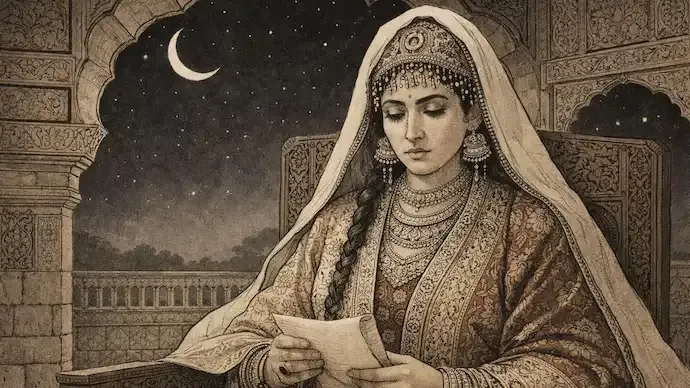

The death of Kashmir’s ruler Rinchan in 1323 created a sudden and dangerous power vacuum in the Valley. Rinchan, a Buddhist prince from Ladakh who had seized the throne after killing his benefactor Ramachandra, left behind a fragile legacy — a young son too small to rule and a widow caught between rival political forces. That widow was Kota Rani, daughter of the slain Ramachandra, and she would soon emerge as one of the most formidable political figures in Kashmir’s medieval history.
With Rinchan gone, Kashmir stood at a crossroads. The nobility refused to accept the rule of Rinchan’s son, Haider, viewing him as the heir of a foreign usurper rather than a legitimate monarch. Calls grew louder for restoring the old Lohara dynasty, prompting envoys to seek Udyanadeva, brother of former king Sahadeva, who had fled Kashmir during earlier Mongol invasions.
A Strategic Marriage to Retain Power
Recognising the existential threat to her position, Kota Rani acted swiftly. Rather than face political isolation, she proposed marriage to Udyanadeva. The alliance was mutually beneficial. Udyanadeva gained legitimacy through marriage to the reigning queen, while Kota Rani retained her authority within the court. Though Udyanadeva wore the crown, real power rested firmly with Kota Rani, who effectively governed Kashmir.

Historical accounts describe Udyanadeva as a nominal ruler, overshadowed by the queen’s command over administration, diplomacy and military decisions. Her authority became most evident during a grave external threat that soon followed.
Defeating an Invasion Through Deception
When a Turko-Mongol commander named Achala marched toward Kashmir with a large force, memories of earlier devastations resurfaced. As panic spread, Udyanadeva fled toward the mountains, abandoning the kingdom. Kota Rani, however, chose to stay.
She rallied local feudal lords and fortified Srinagar, but also employed a calculated diplomatic ruse. Envoys were sent to Achala offering peaceful surrender and marriage, provided he reduced his military presence before entering the capital. Confident of victory, Achala agreed and dispersed his forces. The moment his army weakened, Kashmiri forces attacked, decisively ending the invasion.
The victory transformed Kota Rani from de facto ruler into the undisputed defender of Kashmir.
The Final Struggle for the Throne
After Udyanadeva’s death around 1338, Kota Rani formally ascended the throne, becoming Kashmir’s last Hindu queen. Yet her reign was immediately challenged from within. Her long-serving minister Shah Mir had quietly built support among emerging Muslim communities and common citizens. The political divide was no longer just dynastic, but ideological.
Kota Rani attempted to sideline Shah Mir by appointing a new chief minister and redistributing wealth to secure loyalty. Shah Mir responded with ruthless efficiency. Her trusted minister was assassinated, her authority collapsed, and Shah Mir seized Srinagar without major resistance.
Historical sources differ on the queen’s final moments. Some suggest she accepted marriage to Shah Mir in a last attempt to protect her sons, only to be imprisoned and later take her own life. Others claim she stabbed herself before the marriage could be consummated.
End of an Era
With Kota Rani’s death in 1339, Hindu rule in Kashmir came to an end. Shah Mir crowned himself Sultan Shams-ud-Din, founding a dynasty that would govern the Valley for nearly two centuries.
Kota Rani’s legacy remains complex — a ruler who used intellect, diplomacy and courage to defend her kingdom, yet ultimately fell to political isolation and betrayal. Her reign marked not just the fall of a queen, but the close of an entire civilisational chapter in Kashmir’s history.






Conversation
Be kind and stay on topic. Comments are moderated; abuse, spam and personal attacks are removed. Report a problem