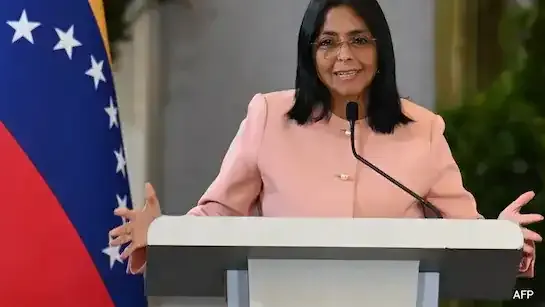
Prime Minister Narendra Modi and Venezuela’s acting President Delcy Rodríguez held a substantive conversation on Friday, agreeing to deepen and expand bilateral cooperation as both countries navigate heightened geopolitical tensions involving the United States. The dialogue reflects New Delhi’s intent to uphold diplomatic engagement with Caracas at a critical moment in Latin American politics.
The discussion marked the first high-level interaction between the Indian prime minister and Rodríguez following a dramatic shift in Venezuela’s political landscape in early January 2026. In an unprecedented development, United States military forces carried out a strike and captured long-time Venezuelan President Nicolás Maduro, prompting international debate and regional instability. In the aftermath, Delcy Rodríguez, previously Venezuela’s vice-president, was sworn in as acting president under the country’s constitutional provisions.
India and Venezuela share decades-old ties that have encompassed energy cooperation, trade and diplomatic engagement. India was once among the world’s largest importers of Venezuelan crude oil, and formal relations between the two nations date back more than 65 years. Even as international sanctions and political headwinds disrupted crude flows in recent years, both countries maintained channels of communication and commercial exchange, including agreements on digital cooperation and energy sector engagement.
In his social media post, Modi said he spoke with Acting President Rodríguez and that both leaders “agreed to further deepen and expand our bilateral partnership in all areas, with a shared vision of taking India-Venezuela relations to new heights in the years ahead.” The statement reflects a mutual interest in strengthening ties across economic, political and cultural domains, even as the wider regional context remains fluid.
The dialogue comes amid significant tensions between Caracas and Washington. Following the January 3 operation, which resulted in Maduro’s detention by US forces, reports have pointed to mixed signals in Washington’s approach to Venezuela’s interim leadership. Some US officials have emphasised cooperation and even preliminary steps to potentially reopen the US embassy in Caracas, closed since 2019, amid broader efforts to stabilise political governance. Meanwhile, intelligence assessments have raised questions about the interim government’s long-term alignment with American goals.
Delcy Rodríguez, a long-time figure in Venezuelan politics, has served in several senior roles, including foreign minister and intelligence chief, and has navigated complex domestic and international dynamics throughout her career. Her ascent to the interim presidency has been marked by both internal support from Venezuela’s security establishment and external scrutiny, particularly from US lawmakers, as the future of Venezuelan governance remains uncertain.
The India-Venezuela dialogue illustrates New Delhi’s sustained foreign policy priority of engaging with countries across different geopolitical blocs, emphasising sovereign equality and mutual respect. With both leaders committed to advancing cooperation, the conversation signals an intent to broaden the bilateral agenda even as broader global tensions persist.
Prev Article
Inside the Himalayan Menu Served to EU Leaders at Rashtrapati Bhavan
Next Article
Trump’s $1,000 Newborn Scheme Mirrors Indian Welfare Ideas, Raising Questions on Inspiration