Shopping cart
Your cart empty!


Your cart empty!
Terms of use dolor sit amet consectetur, adipisicing elit. Recusandae provident ullam aperiam quo ad non corrupti sit vel quam repellat ipsa quod sed, repellendus adipisci, ducimus ea modi odio assumenda.
Lorem ipsum dolor sit amet consectetur adipisicing elit. Sequi, cum esse possimus officiis amet ea voluptatibus libero! Dolorum assumenda esse, deserunt ipsum ad iusto! Praesentium error nobis tenetur at, quis nostrum facere excepturi architecto totam.
Lorem ipsum dolor sit amet consectetur adipisicing elit. Inventore, soluta alias eaque modi ipsum sint iusto fugiat vero velit rerum.
Sequi, cum esse possimus officiis amet ea voluptatibus libero! Dolorum assumenda esse, deserunt ipsum ad iusto! Praesentium error nobis tenetur at, quis nostrum facere excepturi architecto totam.
Lorem ipsum dolor sit amet consectetur adipisicing elit. Inventore, soluta alias eaque modi ipsum sint iusto fugiat vero velit rerum.
Dolor sit amet consectetur adipisicing elit. Sequi, cum esse possimus officiis amet ea voluptatibus libero! Dolorum assumenda esse, deserunt ipsum ad iusto! Praesentium error nobis tenetur at, quis nostrum facere excepturi architecto totam.
Lorem ipsum dolor sit amet consectetur adipisicing elit. Inventore, soluta alias eaque modi ipsum sint iusto fugiat vero velit rerum.
Sit amet consectetur adipisicing elit. Sequi, cum esse possimus officiis amet ea voluptatibus libero! Dolorum assumenda esse, deserunt ipsum ad iusto! Praesentium error nobis tenetur at, quis nostrum facere excepturi architecto totam.
Lorem ipsum dolor sit amet consectetur adipisicing elit. Inventore, soluta alias eaque modi ipsum sint iusto fugiat vero velit rerum.
Do you agree to our terms? Sign up
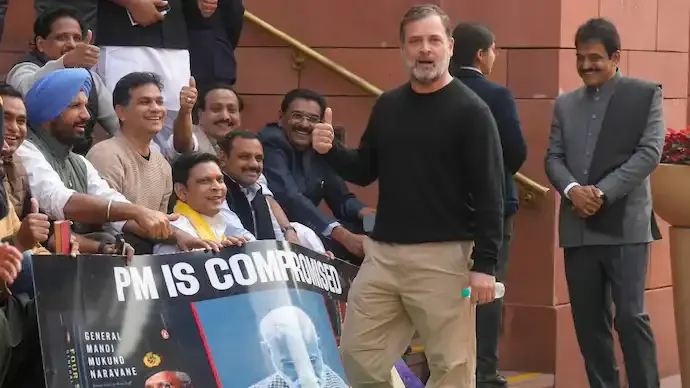
Congress leader Rahul Gandhi emerged as one of the most prominent voices during the first phase of Parliament’s Budget session, adopting a combative approach that placed sustained pressure on the government and energised Opposition benches. His extended interventions, sharp rebuttals, and refusal to yield ground during heated exchanges positioned him at the centre of the political narrative inside the House.
Gandhi’s assertive tone appeared to galvanise Congress MPs, who rallied behind their leader through coordinated protests, slogan-raising, and demonstrations following suspensions. The visible camaraderie among Opposition members reflected an effort to project unity and amplify the party’s political messaging.
Soon after the parliamentary exchanges, Gandhi met with a group of farmers, signalling the party’s intent to frame itself as pro-farmer and critical of recent economic and trade developments. The meeting reinforced the Opposition’s attempt to shape public perception around agricultural concerns and rural livelihoods.
However, political observers note that symbolism alone may not translate into electoral gains. The Congress faces the challenge of converting messaging into grassroots mobilisation and sustained engagement with rural communities.
The party’s broader difficulty lies in transforming parliamentary interventions into mass outreach. Recent campaigns and protests have struggled to build sustained momentum, highlighting organisational gaps at the grassroots level. Without stronger local mobilisation, analysts suggest that political messaging risks remaining confined to legislative debates and media discourse.
National security is expected to remain a major focus in the second half of the session and beyond. Gandhi has raised questions related to strategic decision-making and military preparedness, signalling an intent to challenge the government’s narrative on leadership and national security.
With assembly elections approaching in states such as West Bengal, Assam, Tamil Nadu, and Kerala, political messaging is likely to intensify. The Opposition is expected to frame national security, governance, and economic issues as central campaign themes.
The Congress is also expected to amplify selected controversies and policy critiques through social media outreach, aiming to sustain political pressure and shape public discourse ahead of the next parliamentary phase.
Gandhi’s assertive body language and rhetorical style during the session suggest a renewed political energy within the party leadership. Whether this momentum translates into broader political mobilisation remains uncertain.
The coming weeks will test whether the Opposition can convert parliamentary performance into sustained public engagement. The effectiveness of this strategy will depend on organisational strength, messaging consistency, and the ability to connect legislative debate with ground-level concerns.
As Parliament reconvenes, the focus will shift from rhetorical confrontation inside the House to political mobilisation outside it — a transition that may determine the Opposition’s influence in the months ahead.
62
Published: Feb 14, 2026

All India Story is your trusted source for comprehensive and up-to-the-minute news coverage across India. Bringing you the latest on politics, business, technology, entertainment, sports, and more, we are dedicated to keeping you informed with accurate, engaging, and insightful stories from every corner of the nation.