

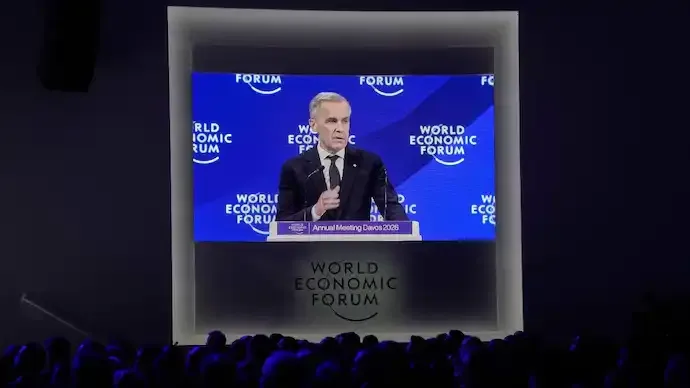
The long-standing assumptions surrounding the global rules-based international order came under sharp scrutiny at the World Economic Forum in Davos, as Canadian Prime Minister Mark Carney delivered one of the most direct critiques yet of the US-led global system. Speaking before world leaders and policymakers, Carney declared that the era of American-dominated global governance has effectively ended, replaced by a more fractured and coercive international landscape.
Addressing the forum in Davos, Carney said the world is not witnessing a gradual transition, but a fundamental rupture. According to him, the principles that once underpinned global cooperation—free trade, mutual benefit, and predictable rules—no longer function as promised. He argued that powerful nations increasingly exempt themselves from these rules when it suits their strategic interests.
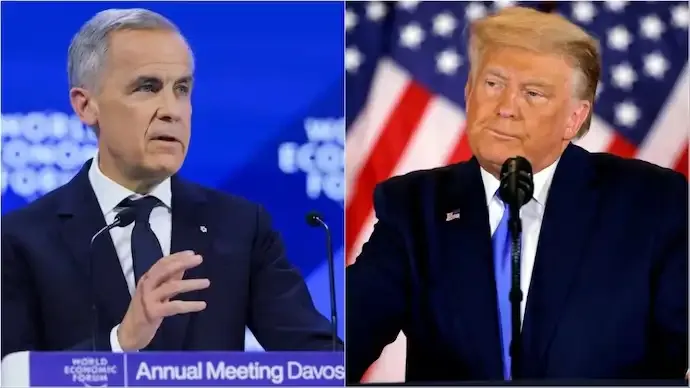
Without directly naming the United States or Donald Trump, Carney criticised what he described as American hegemony and the selective enforcement of international norms. He noted that while the so-called rules-based order was presented as fair and universal, it often operated asymmetrically. The strongest players, he said, benefited most while avoiding accountability.
Carney pointed to recent global shocks across finance, public health, energy, and geopolitics as evidence that deep economic interdependence has become a liability rather than a safeguard. Trade systems, financial infrastructure, and supply chains—once symbols of cooperation—are now being weaponised. Tariffs are increasingly used as leverage, financial networks as instruments of coercion, and supply chains as strategic pressure points.
For Canada, these shifts carry serious implications. Carney warned that relying solely on geography, historical alliances, or proximity to major powers is no longer sufficient to guarantee economic security or political autonomy. He cautioned against what he described as the illusion of mutual benefit when integration itself becomes a source of vulnerability.
The Canadian leader called for a more “principled and pragmatic” national strategy, urging countries to strengthen domestic production capacities while diversifying trade relationships. He acknowledged that global institutions such as the World Trade Organization and the United Nations have been weakened, forcing nations—particularly middle powers—to rethink their approach to security and cooperation.
Carney stressed that self-reliance in food, energy, and defence is now critical. In a world where rules fail to protect weaker participants, he argued, nations must be prepared to protect themselves. However, he also warned against a future dominated by isolationism, describing a “world of fortresses” as poorer, more unstable, and more dangerous.
Instead, he advocated for flexible coalitions among like-minded countries, asserting that middle powers have a crucial role to play in shaping a fairer global system. His remarks underscored that clinging to nostalgia about the past is unproductive, and that new frameworks must emerge from the current global fracture.
Carney’s speech coincided with growing unease among European leaders. French President Emmanuel Macron echoed similar concerns, condemning what he described as aggressive economic and territorial posturing. Macron criticised threats linked to control over Greenland, calling such behaviour incompatible with international law and respect for sovereignty.
Together, these statements signalled a widening transatlantic rift and a deepening debate over the future of global power, trade, and cooperation.

Conversation
Be kind and stay on topic. Comments are moderated; abuse, spam and personal attacks are removed. Report a problem