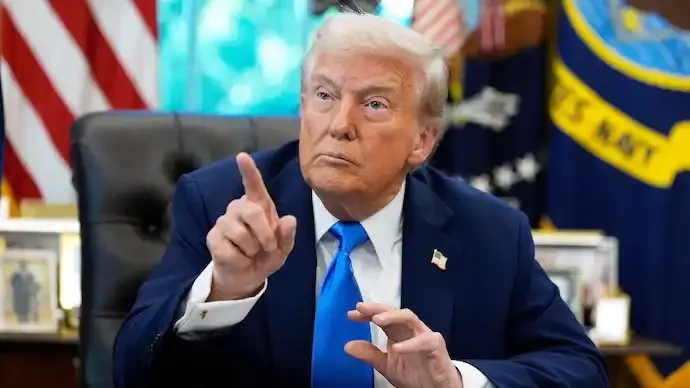
US President Donald Trump on Thursday announced the formation of a Gaza Board of Peace, describing it as a central component of phase two of a US-backed framework aimed at ending the prolonged conflict in Gaza and transitioning the territory toward post-war governance.
The announcement was made through a post on Trump’s Truth Social platform, where he said the newly created board would oversee a technocratic Palestinian administration responsible for managing Gaza’s civilian affairs during a transitional period.
“It is my great honor to announce that THE BOARD OF PEACE has been formed,” Trump wrote, adding that the members would be revealed soon and describing the panel as one of the most prestigious international bodies ever assembled.
Technocratic Governance Model for Gaza
Under the proposed plan, the Board of Peace will supervise a National Committee for the Administration of Gaza, a technocratic body tasked with handling day-to-day governance, public services, and reconstruction efforts once active hostilities subside.
Trump said he would serve as chairman of the board and expressed confidence that the Palestinian leaders selected for the committee are committed to a peaceful and stable future for Gaza.
The move follows remarks earlier this week by Trump’s special envoy Steve Witkoff, who said the plan envisions the creation of a transitional Palestinian administration that would operate independently of militant groups while coordinating closely with international stakeholders.
Phase Two Focuses on Governance and Disarmament
Phase two of the US-backed plan marks a shift from ceasefire negotiations to governance, reconstruction, and security restructuring in Gaza. According to officials familiar with the framework, this stage will also initiate discussions on the disarmament of armed groups, a process expected to face significant resistance.
One of the most complex challenges will be addressing the role of Hamas, which has historically refused to surrender its weapons. While Hamas agreed in October to step back from day-to-day governance, it has not committed to full disarmament.
The plan also raises the possibility of deploying an international peacekeeping force to stabilise Gaza during the transition, though details regarding troop composition, mandate, and regional consent remain unclear.
Setbacks in Phase One
The first phase of the US-backed Gaza plan has encountered multiple obstacles, including renewed Israeli airstrikes, delays in reopening Gaza’s crossing with Egypt, and unresolved issues related to hostages taken during earlier stages of the conflict.
Despite these setbacks, mediators including Egypt, Qatar, and Turkey have reaffirmed their support for the transition framework.
According to a joint mediation proposal, the technocratic administration will consist of 15 members and will be led by Ali Shaath, a former deputy minister associated with the Palestinian Authority who previously oversaw industrial development projects.
Israel, Hamas Sign On — Uncertainty Remains
Both Israel and Hamas signed onto the broader framework in October, agreeing in principle to an internationally supervised transition once fighting reduces. However, analysts note that implementation hinges on whether militant factions can be compelled to disarm — a condition Trump’s envoy described as essential for lasting peace.
Witkoff said phase two would prioritise “the full demilitarisation and reconstruction of Gaza,” with an emphasis on removing weapons from all unauthorised armed groups.
As Gaza remains fragile under a tenuous ceasefire, Trump’s announcement signals a renewed push by Washington to shape the post-war political order in the territory. Whether the Board of Peace can translate ambition into stability will depend on cooperation from regional powers, Palestinian factions, and Israel — and on overcoming deep-rooted mistrust built over decades of conflict.