Shopping cart
Your cart empty!


Your cart empty!
Terms of use dolor sit amet consectetur, adipisicing elit. Recusandae provident ullam aperiam quo ad non corrupti sit vel quam repellat ipsa quod sed, repellendus adipisci, ducimus ea modi odio assumenda.
Lorem ipsum dolor sit amet consectetur adipisicing elit. Sequi, cum esse possimus officiis amet ea voluptatibus libero! Dolorum assumenda esse, deserunt ipsum ad iusto! Praesentium error nobis tenetur at, quis nostrum facere excepturi architecto totam.
Lorem ipsum dolor sit amet consectetur adipisicing elit. Inventore, soluta alias eaque modi ipsum sint iusto fugiat vero velit rerum.
Sequi, cum esse possimus officiis amet ea voluptatibus libero! Dolorum assumenda esse, deserunt ipsum ad iusto! Praesentium error nobis tenetur at, quis nostrum facere excepturi architecto totam.
Lorem ipsum dolor sit amet consectetur adipisicing elit. Inventore, soluta alias eaque modi ipsum sint iusto fugiat vero velit rerum.
Dolor sit amet consectetur adipisicing elit. Sequi, cum esse possimus officiis amet ea voluptatibus libero! Dolorum assumenda esse, deserunt ipsum ad iusto! Praesentium error nobis tenetur at, quis nostrum facere excepturi architecto totam.
Lorem ipsum dolor sit amet consectetur adipisicing elit. Inventore, soluta alias eaque modi ipsum sint iusto fugiat vero velit rerum.
Sit amet consectetur adipisicing elit. Sequi, cum esse possimus officiis amet ea voluptatibus libero! Dolorum assumenda esse, deserunt ipsum ad iusto! Praesentium error nobis tenetur at, quis nostrum facere excepturi architecto totam.
Lorem ipsum dolor sit amet consectetur adipisicing elit. Inventore, soluta alias eaque modi ipsum sint iusto fugiat vero velit rerum.
Do you agree to our terms? Sign up
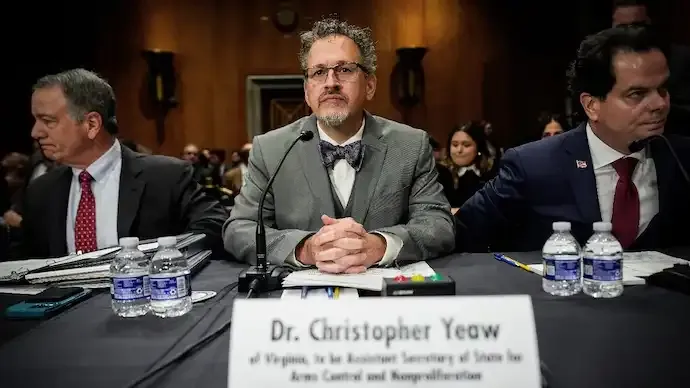
The United States has disclosed newly declassified information regarding an alleged underground nuclear test conducted by China and urged greater transparency and renewed global efforts toward nuclear disarmament. The disclosure comes at a time of rising concern over nuclear proliferation and the expiration of key arms control limits between major powers.
A senior US arms control official presented the details before a UN-backed disarmament forum in Geneva, warning that China’s nuclear expansion could bring it to parity with the United States and Russia within the next five years.
According to US officials, a seismic event detected on June 22, 2020, at China’s Lop Nur test site in Xinjiang registered a magnitude of 2.75. Data from international monitoring systems indicated the event resembled an explosion rather than a natural earthquake or mining activity.
Officials said signal patterns were consistent with a single explosive event. They also raised concerns that monitoring China’s testing activities remains difficult due to limited transparency and restricted access to monitoring infrastructure.
China has denied conducting any nuclear explosive test and rejected the allegations as unfounded.
US officials warned that China has rapidly expanded its nuclear arsenal in recent years, describing the buildup as unprecedented and opaque. Washington estimates that China’s stockpile has grown from the low 200s in 2020 to more than 600 warheads and could exceed 1,000 by 2030.
The United States expressed concern over the lack of clarity regarding Beijing’s long-term nuclear objectives and called for greater openness regarding its strategic intentions.
The disclosure comes shortly after the expiration of the last remaining nuclear arms treaty limiting US and Russian arsenals. The end of these constraints has heightened fears of a renewed global arms race.
Officials also pointed out that previous agreements did not address non-strategic nuclear weapons or include China, leaving significant gaps in arms control frameworks.
China’s representative to the disarmament conference dismissed the claims, stating that Beijing adheres to its commitments to suspend nuclear testing and supports the objectives of the Comprehensive Nuclear-Test-Ban Treaty.
Chinese officials argued that the country’s nuclear arsenal remains significantly smaller than those of the United States and Russia and described calls for trilateral arms control negotiations as unfair and impractical.
The issue has also reignited debate in the United States about nuclear testing policy. Some defence experts argue that renewed testing may be needed to ensure reliability of aging arsenals, while officials maintain that any testing would not involve explosive detonations.
Analysts warn that allegations of nuclear testing by rival powers could increase pressure on nuclear states to modernise or expand their arsenals.
The United States has urged the international community to encourage China and Russia to participate in broader multilateral arms control negotiations.
Observers note that rising geopolitical tensions, rapid military modernisation, and weakening treaty frameworks are reshaping the global nuclear landscape.
The latest disclosures underscore the growing urgency for transparency, confidence-building measures, and renewed diplomatic engagement to prevent a new nuclear arms race.
57
Published: Feb 24, 2026

All India Story is your trusted source for comprehensive and up-to-the-minute news coverage across India. Bringing you the latest on politics, business, technology, entertainment, sports, and more, we are dedicated to keeping you informed with accurate, engaging, and insightful stories from every corner of the nation.