
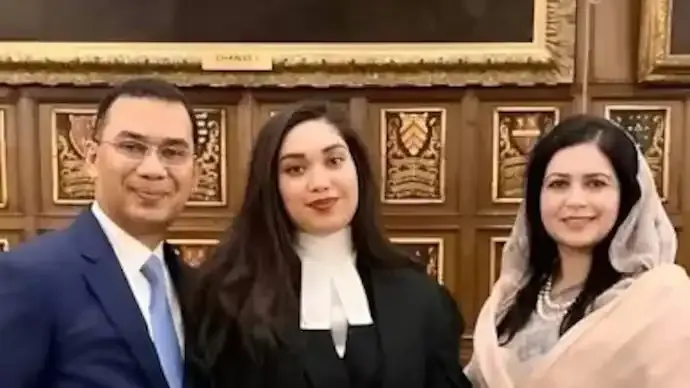
After spending nearly 17 years in exile, Bangladesh Nationalist Party (BNP) leader Tarique Rahman has returned to Bangladesh, bringing with him a new and closely watched figure in Dhaka’s political arena — his daughter Zaima Rahman.
Zaima’s arrival has sparked fresh interest within political circles, as the London-trained barrister takes her first cautious steps into Bangladesh’s complex and often turbulent political environment. While the focus of the homecoming has largely remained on Tarique Rahman, images of Zaima alongside her parents quickly went viral, signalling the possible emergence of a new generational voice within the BNP.
In a recent social media post ahead of her return, Zaima spoke of reconnecting with her roots and affectionately referred to her grandmother, former prime minister Khaleda Zia, as “Dadu”. The post revived public memory of the BNP’s political lineage spanning three generations.
Background and professional life
Zaima Rahman is the only daughter of Tarique Rahman and the granddaughter of two of Bangladesh’s most influential political figures — Khaleda Zia and the late President Ziaur Rahman. She was educated in the United Kingdom and trained as a barrister, spending most of her adult life in London.
Unlike many scions of South Asian political dynasties, Zaima has so far avoided formal political roles. She has neither contested elections nor held any official position within the BNP, maintaining a low public profile until recent years.
Early public attention and personal anecdotes
Zaima first appeared in the public eye during the 2001 general elections when, as a child, she accompanied Khaleda Zia to a polling booth — a moment that resurfaced in media narratives following her return. In a recent post, she recalled childhood memories of visiting her grandmother’s office after winning a school football tournament, describing Khaleda Zia’s pride and attentiveness as formative influences.
From background presence to political visibility
Zaima’s name entered national headlines in 2021 after then Awami League minister Murad Hasan made derogatory remarks about her, an incident that eventually led to his resignation and legal proceedings. However, it was after Bangladesh’s student-led July movement that Zaima began to assume a more visible role.
She has since accompanied and represented her father at several international and political events, including the National Prayer Breakfast in Washington, DC, and meetings with European representatives as part of BNP delegations. In November 2025, she attended her first formal BNP meeting alongside senior party leaders, marking a notable step into active political engagement.
A generational reset for the BNP?
Zaima Rahman’s return coincides with the BNP’s attempt to rebrand itself ahead of the February 2026 national elections. With Tarique Rahman seeking to reshape his political image after years of allegations linked to corruption and abuse of power during the BNP–Jamaat coalition era, Zaima’s presence is being viewed by some analysts as an effort to connect with younger voters and project renewal.
In her recent statements, Zaima said she hopes to contribute to rebuilding Bangladesh and understanding its people through direct engagement rather than distant memory. She emphasised learning from lived experiences and supporting her family during a politically volatile period.
Zaima has not announced plans to contest elections or assume a formal party role. However, her growing visibility, public messaging and participation in key political interactions have fuelled speculation about a larger role in the future. As Bangladesh heads into a tense election season marked by polarisation and unrest, Zaima Rahman’s emergence adds a new and closely watched dimension to the country’s evolving political landscape.


Conversation
Be kind and stay on topic. Comments are moderated; abuse, spam and personal attacks are removed. Report a problem