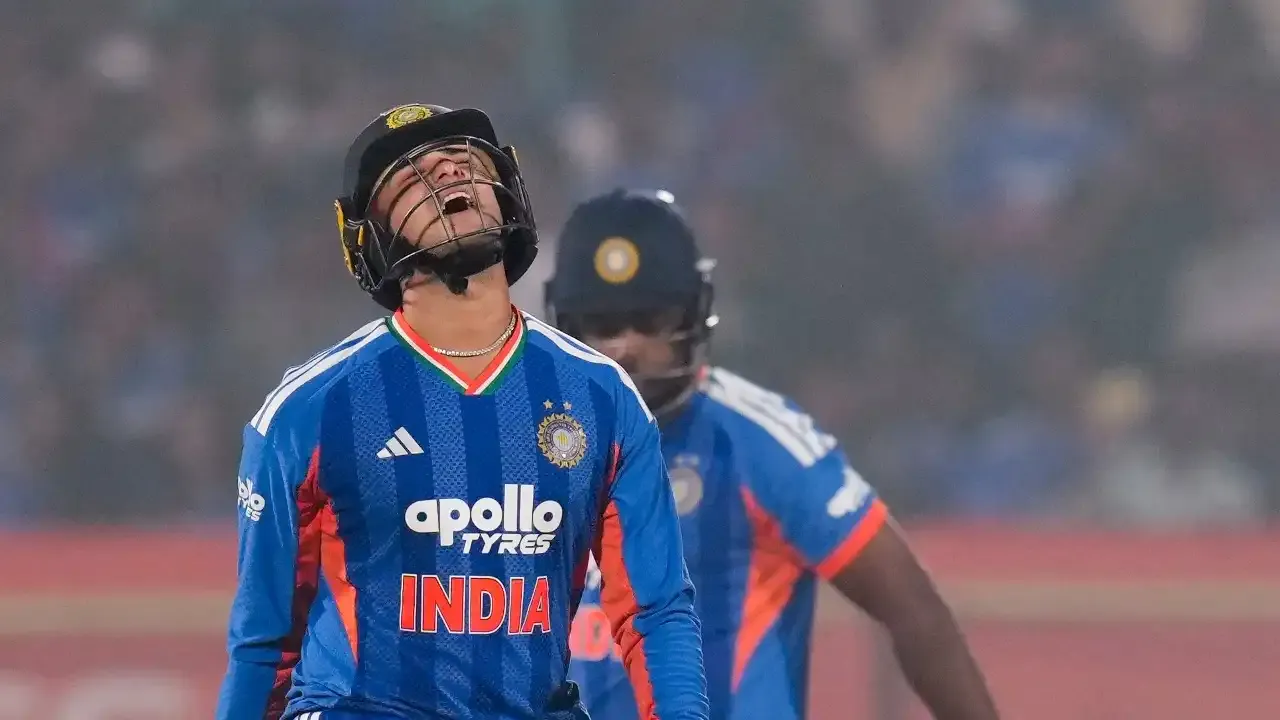
India’s aggressive approach at the top of the order has sparked debate once again, and former India batter Ajinkya Rahane believes the risks involved could ultimately help the team prepare better for the pressures of the upcoming T20 World Cup.
Rahane’s comments came after India’s 50-run defeat against New Zealand in the fourth T20I in Vizag, a match that exposed vulnerabilities in India’s batting when opener Abhishek Sharma failed to deliver his customary explosive start. Chasing a steep target of 216, Abhishek was dismissed for a golden duck, attempting an ambitious first-ball shot that ended in the deep.
The early dismissal triggered a broader discussion around India’s reliance on Abhishek’s fearless style at the top. When his attacking approach succeeds, it often sets the tone for dominant wins. But when it fails, the rest of the batting order is forced to adapt under pressure — a scenario Rahane believes is essential preparation for global tournaments.
Speaking during a post-match analysis, Rahane said such outcomes are an inevitable part of modern T20 cricket. According to him, Abhishek’s game is built on calculated risk, and occasional failures should not be viewed as setbacks but as learning opportunities for the team as a whole.
Rahane pointed out that in high-stakes events like the T20 World Cup, teams cannot afford to rely on one batter for momentum. He stressed that Abhishek’s style compels the rest of the batting unit to take responsibility and develop the ability to absorb pressure if the top order collapses early.
The Vizag match underlined this challenge. After Abhishek’s first-ball dismissal, India’s top order struggled to regain control of the chase. Suryakumar Yadav and Sanju Samson fell cheaply, leaving the side reeling in the powerplay. The collapse exposed the thin margin for error when chasing large totals with an ultra-attacking approach.
Despite the setback, Abhishek’s overall series performance has been impressive. He finished as the third-highest run-scorer with 152 runs from four matches, averaging over 50 at a strike rate well above 260. His blistering 14-ball fifty earlier in the series showcased his ability to win matches almost single-handedly inside the powerplay.
India’s team composition in Vizag also played a role. With Ishan Kishan sidelined due to a niggle, the team opted for additional bowling depth, effectively playing with fewer specialist batters. This placed added responsibility on the middle order once early wickets fell.
The middle-order response showed promise. Rinku Singh, promoted to number four, attempted to stabilise the innings, while Shivam Dube launched a powerful counterattack. Dube’s rapid half-century briefly revived hopes, even as Hardik Pandya endured an uncharacteristic failure.
Although the late surge was not enough to overturn the deficit, Rahane believes such matches are valuable ahead of the World Cup. They expose weaknesses, clarify roles, and underline the importance of adaptability under pressure.
As India fine-tunes its strategy ahead of the global tournament, Abhishek Sharma’s high-risk batting remains both a weapon and a test. Rahane’s assessment suggests that learning to cope with its failures may be just as important as benefiting from its successes.
Prev Article
After T20 World Cup Boycott, Bangladesh Allows Shooting Team to Travel to India
Next Article
Ashwin Denies Indirect Dig at Virat Kohli, Says He Spoke to Him Amid Social Media Row