

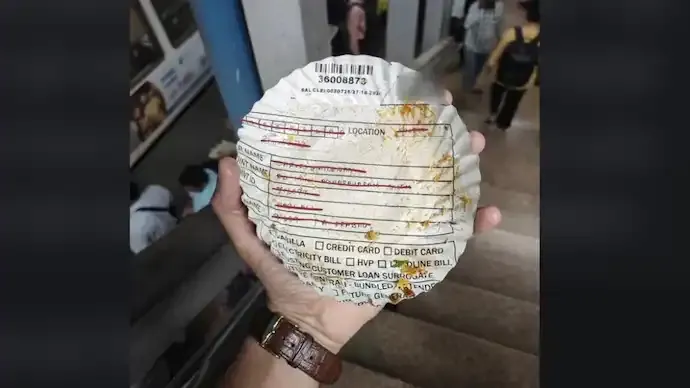

A viral image circulating on social media has ignited a wider debate on data privacy and the handling of sensitive financial information in India. The photograph shows what appears to be a roadside food plate made from reused bank or financial documents, with customer details still partially visible — a discovery that has left many questioning how such paperwork enters the public recycling chain.
The image was shared on X by a popular account, accompanied by a caption suggesting that personal data protection in India is alarmingly fragile. The photograph shows a paper plate holding street food, with printed fields such as names, locations, and what appear to be payment or account-related details faintly visible beneath food stains. While some information appears scribbled out, portions remain legible.
The setting appears to be a busy public transit area, possibly near a railway station or metro exit, with commuters visible in the background. The juxtaposition of sensitive financial information being repurposed as disposable crockery struck a chord online, quickly turning the post viral.

Social media users reacted with a mix of concern, disbelief, and dark humour. Many flagged the incident as a glaring example of how improper disposal of confidential documents can expose individuals to serious risks such as identity theft, financial fraud, and unauthorised access to personal data.
Several users questioned how documents containing customer information could be sold or passed on as scrap paper in the first place. Some demanded accountability from financial institutions, arguing that banks and similar entities must ensure sensitive records are securely shredded or destroyed before disposal. Others pointed out that even partially redacted information can be exploited if it falls into the wrong hands.
The incident also triggered a broader discussion on the informal recycling ecosystem, where discarded paper often changes multiple hands before being reused. Without strict checks, sensitive documents can easily slip into this chain, eventually resurfacing in unexpected and inappropriate forms — such as disposable plates or packaging.
Experts note that while India has been strengthening its digital and data protection frameworks, lapses in physical document handling remain a weak link. Financial institutions routinely generate large volumes of paperwork, and improper disposal practices can undermine broader efforts to safeguard customer data.
The viral image has also renewed calls for stricter enforcement of data handling norms and better awareness among organisations about the risks posed by careless paper disposal. Users highlighted that data privacy is not just a digital issue but also extends to how physical records are managed after use.
Although the origin of the document seen in the image has not been identified, the episode has become a talking point about systemic gaps in data protection practices. Many online commentators stressed that such incidents erode public trust and highlight the need for clearer accountability mechanisms.
As the debate continues, the image serves as a stark reminder that data security does not end once information is printed. In an age where personal and financial details are highly valuable, even something as mundane as a paper plate can become a symbol of deeper vulnerabilities in how sensitive information is treated.








Conversation
Be kind and stay on topic. Comments are moderated; abuse, spam and personal attacks are removed. Report a problem