

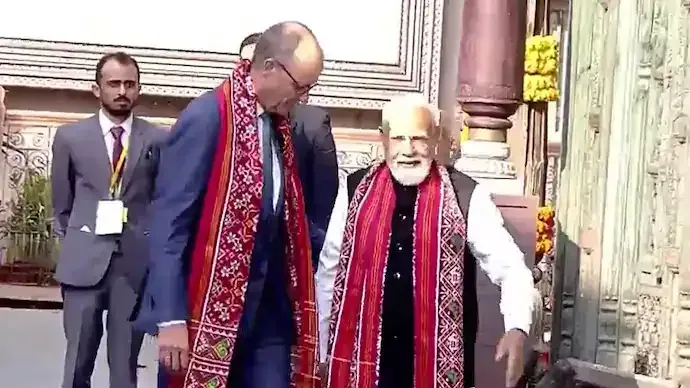

German Chancellor Friedrich Merz began his maiden official visit to India with a symbolic and culturally rich engagement in Ahmedabad, where he met Prime Minister Narendra Modi, flew kites at the International Kite Festival, and paid tribute at Sabarmati Ashram.
Merz arrived at the Sardar Vallabhbhai Patel International Airport on Sunday night, marking the start of a two-day visit aimed at strengthening the India–Germany Strategic Partnership. His first day in Gujarat blended diplomacy with cultural outreach, reflecting New Delhi’s emphasis on people-to-people connections alongside formal state engagements.
The two leaders met in Ahmedabad on Monday morning before proceeding to the Sabarmati Ashram, where Merz was introduced to Mahatma Gandhi’s philosophy of non-violence and self-reliance. The visit underscored the shared democratic values that India and Germany frequently highlight in their bilateral engagements.

Later, Prime Minister Modi and Chancellor Merz participated in the International Kite Festival at the Sabarmati Riverfront, a signature cultural event held annually during Makar Sankranti. The image of the two leaders flying kites was widely seen as a gesture of goodwill and friendship, signalling a fresh momentum in India-Germany relations.
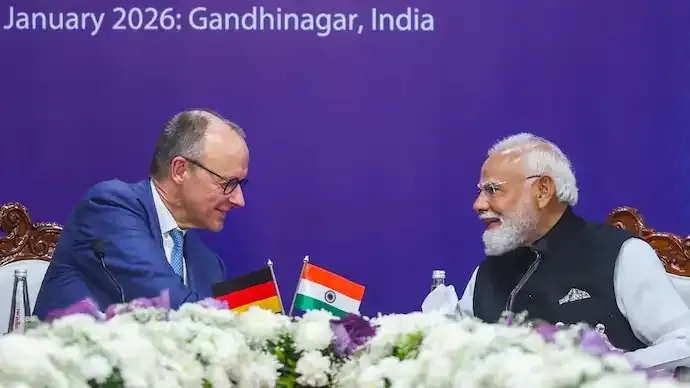
Formal bilateral talks between the delegations were scheduled to begin at Mahatma Mandir, where discussions are expected to focus on reviewing progress under the India–Germany Strategic Partnership, which recently completed 25 years. Officials indicated that the talks would span a broad range of sectors critical to both economies.
Key areas on the agenda include trade and investment, advanced manufacturing, defence cooperation, clean energy, climate action, education, innovation, and skilled workforce mobility. Germany remains one of India’s most important economic partners within the European Union, particularly in areas such as industrial technology, green hydrogen, and sustainable infrastructure.
The leaders are also expected to discuss cooperation in science and research, digital transformation, and emerging technologies, reflecting shared concerns over global supply chain resilience and technological self-reliance. Defence and security collaboration, including joint production and technology transfers, is also likely to feature prominently in the discussions.
Merz’s visit follows his previous interaction with Prime Minister Modi on the sidelines of the G7 Summit, where both leaders agreed to elevate bilateral cooperation. During that meeting, Modi formally invited the German leader to visit India, setting the stage for the current engagement.
The timing of the visit is also significant, coming just weeks ahead of the India–EU Summit scheduled for January 27. Germany plays a central role within the European Union, and its alignment with India on global issues such as climate change, geopolitical stability, and economic diversification is viewed as strategically important.
Officials on both sides have indicated that the visit aims to inject renewed political momentum into the partnership, moving beyond dialogue to implementation-driven cooperation. As India positions itself as a key global manufacturing and innovation hub, Germany’s expertise in high-end engineering and sustainable development is seen as a natural complement.
Chancellor Merz’s maiden visit, marked by cultural symbolism and substantive diplomacy, reflects the evolving depth of India-Germany ties as both nations look to navigate a rapidly changing global order together.





Conversation
Be kind and stay on topic. Comments are moderated; abuse, spam and personal attacks are removed. Report a problem