

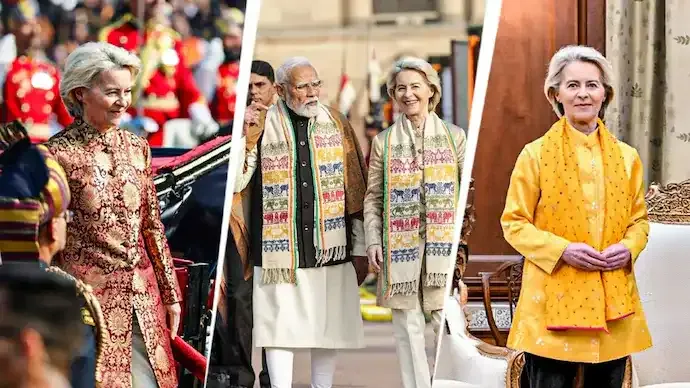

Fashion diplomacy is a delicate balancing act, and few global leaders manage to strike the right note when dressing for India. During her recent visit, Ursula von der Leyen emerged as a rare exception, earning widespread praise for sartorial choices that felt informed, respectful, and refreshingly restrained.
Instead of leaning into exaggerated or costume-like interpretations of Indian wear, the European Commission President opted for Indian silhouettes and textiles with quiet confidence. Her wardrobe choices reflected a deep appreciation for craftsmanship rather than surface-level symbolism, showcasing how fashion can act as a subtle yet powerful diplomatic language.
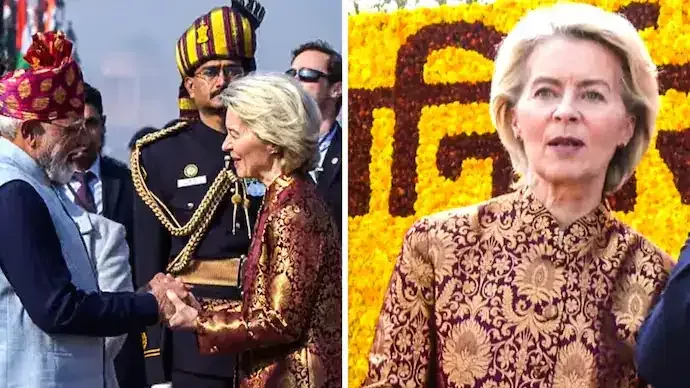
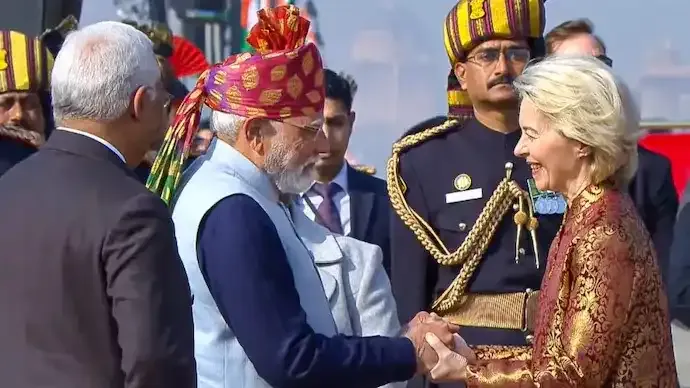
Her Indian fashion narrative began at the Republic Day Parade, where she attended as chief guest wearing a maroon-and-gold brocade bandhgala jacket by Indian designer Rajesh Pratap Singh. Crafted in Banarasi brocade, the outfit paid homage to the weavers of Varanasi while retaining a sharp, modern silhouette befitting a global leader.

A moment that stood out for its symbolism came during her interaction with Narendra Modi, where von der Leyen paired a beige-gold bandhgala with an eri silk stole — the same stole featured in India’s Republic Day 2026 invitations. The Prime Minister was also seen wearing the stole, creating a visual alignment that underscored cultural respect without overt messaging.
Eri silk, a speciality of India’s Northeast, is known as Eri in Assam and Ryndia in Meghalaya. Often referred to as Ahimsa silk, it carries deep cultural significance rooted in sustainable and traditional weaving practices. By incorporating it seamlessly into her outfit, von der Leyen brought attention to a lesser-known Indian textile without making it feel performative.
Another striking moment came during the 16th EU–India Summit at Hyderabad House, where she announced a landmark trade agreement alongside Prime Minister Modi. For the occasion, she chose an electric blue satin silk bandhgala by Anamika Khanna, featuring resham hand embroidery and tonal three-dimensional floral detailing. The look balanced contemporary tailoring with traditional techniques, reinforcing the idea of partnership through design.
Her engagement with Indian fashion continued at a banquet hosted at Rashtrapati Bhavan, where she wore a yellow kurta jacket by Abraham and Thakore, paired with a yellow-and-red bandhani crinkled stole from Rajasthan. Known globally for her sharp power suits, von der Leyen’s decision to consistently step away from Western tailoring during the visit was widely seen as deliberate and meaningful.
Fashion observers noted that her approach stood apart from past attempts at fashion diplomacy by visiting dignitaries. While some leaders have played it too safe by sticking rigidly to Western attire, others have gone overboard, resulting in outfits that bordered on theatrical rather than respectful. In contrast, von der Leyen’s wardrobe choices felt cohesive, regionally diverse, and rooted in genuine appreciation.
Her India visit demonstrated that when fashion is guided by cultural understanding rather than optics, it can become a powerful tool of diplomacy. Von der Leyen did not treat Indian attire as a checklist of ethnic elements. Instead, she allowed craftsmanship, context, and subtlety to lead — setting a benchmark for how global leaders can engage with India’s rich sartorial heritage with authenticity and grace.






Conversation
Be kind and stay on topic. Comments are moderated; abuse, spam and personal attacks are removed. Report a problem