

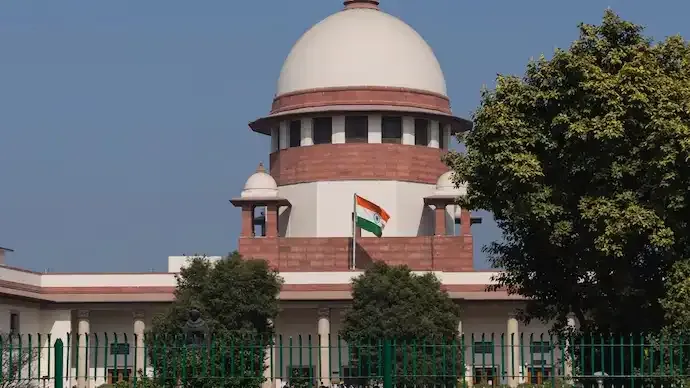

The Supreme Court on Tuesday questioned whether English can be considered an indigenous language while hearing petitions challenging the CBSE's implementation of the three-language formula for Class 6 under the National Education Policy (NEP) 2020.
While refusing to grant an interim stay on the policy, the court observed that the initiative appears to support the constitutional objective of promoting Hindi and other Indian regional languages. The matter has now been listed for further hearing on July 22.
Supreme Court declines interim stay
A Bench comprising Chief Justice Surya Kant, Justice Joymalya Bagchi, and Justice V. Mohan heard a batch of petitions challenging the rollout of the three-language policy.

The court declined to stay the implementation of the policy at this stage, stating that such relief could not be granted without a detailed examination of the issues raised.
The Bench directed the Centre and the Central Board of Secondary Education (CBSE) to file their detailed responses before the next hearing.
Court raises question on English as an indigenous language
During the hearing, the Supreme Court remarked that it may be necessary to revisit whether English should be treated as an indigenous language.
The Bench observed that the three-language framework appears to further the constitutional goal of encouraging the learning of Hindi and other regional Indian languages.
The remarks have added a new dimension to the ongoing debate over multilingual education and language policy in schools.
Petitioners cite implementation challenges
The petitioners argued that implementing the three-language policy would create significant practical difficulties for schools.
According to the submissions:
- Schools may struggle to recruit qualified teachers for all 22 scheduled Indian languages.
- Educational institutions would require additional infrastructure and resources.
- NCERT had announced that study material for all 22 languages would be made available by July 1, but textbooks are reportedly available for only three languages.
The petitioners also pointed out that although CBSE withdrew its earlier circular regarding the compulsory implementation of the third language in Class 9 from the current academic session, concerns over the broader rollout continue.
Centre defends the three-language policy
Representing the Centre and CBSE, the government informed the court that a detailed response would be filed within ten days.
The Centre defended the policy, stating that the National Education Policy 2020 seeks to create an education system rooted in India's cultural and linguistic diversity.
It argued that the three-language formula:
- Promotes multilingualism.
- Respects India's federal structure.
- Supports national integration.
- Provides flexibility to states and students.
- Does not impose any particular language on any state.
According to the government, the policy aims to strengthen Indian languages while allowing states to implement the framework according to their regional needs.
Matter to be heard again on July 22
The Supreme Court has scheduled the next hearing for July 22, when it will consider detailed submissions from the Centre and CBSE before deciding on further proceedings.
For now, the three-language policy will continue without any interim stay.
Key Highlights
- Supreme Court refused to stay the CBSE three-language policy for Class 6.
- The Bench questioned whether English can be considered an indigenous language.
- The court observed that the policy appears to support the promotion of Hindi and regional languages.
- Petitioners cited teacher shortages and lack of textbooks as key implementation challenges.
- The Centre defended the policy under NEP 2020, saying no language is being imposed.
- The next hearing is scheduled for July 22.
FAQs
What did the Supreme Court say about English?
The Supreme Court remarked that it may be worth reconsidering whether English can be regarded as an indigenous language while hearing challenges to the CBSE three-language policy.
Did the Supreme Court stay the CBSE three-language policy?
No. The court declined to grant an interim stay and said the matter requires a detailed hearing.
Why has the policy been challenged?
Petitioners argue that schools may face difficulties in appointing teachers for multiple languages and that learning materials are not yet available for all scheduled languages.
What is the Centre's stand?
The Centre says the policy is part of the National Education Policy 2020 and promotes multilingualism while ensuring that no language is imposed on any state.
When will the Supreme Court hear the case again?
The matter has been listed for further hearing on July 22.







Conversation
Be kind and stay on topic. Comments are moderated; abuse, spam and personal attacks are removed. Report a problem