



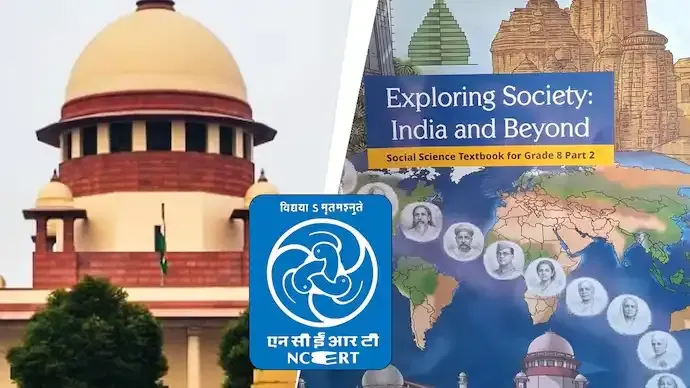
The National Council of Educational Research and Training (NCERT) has withdrawn a newly released Class 8 Social Science textbook after the Supreme Court of India raised objections to references concerning judicial corruption. The council described the inclusion of the material as “purely unintentional” and issued an apology, stating that the content would be revised.
The controversy centres on Chapter 4 of the textbook titled Exploring Society: India and Beyond, Volume II. The chapter, “The Role of the Judiciary in Our Society,” discussed structural challenges faced by courts, including judge shortages, procedural delays, infrastructure gaps, and case backlogs. It also included references to how corruption concerns may affect public confidence in the justice system.
Following strong observations from the Supreme Court, NCERT placed the book’s distribution on immediate hold and removed it from circulation. The council said the chapter will now be rewritten in consultation with appropriate authorities and reissued for the 2026–27 academic session.

Supreme Court Takes Cognisance
The matter reached the Supreme Court after being mentioned for urgent hearing before a bench led by Chief Justice Surya Kant. Senior advocates Kapil Sibal and Abhishek Singhvi brought the issue to the court’s attention.
The Chief Justice reportedly expressed serious concern over the references, stating that the judiciary’s integrity should not be questioned in educational material. The court observed that it would not permit any attempt to undermine or defame constitutional institutions. Concerns were also said to have been raised by members of the judiciary regarding the textbook’s content.
NCERT’s Response
In its official statement, NCERT clarified that the objective of the new textbooks is to promote constitutional literacy, respect for institutions, and informed democratic participation among students. The council emphasised that it holds the judiciary in the highest regard as the guardian of the Constitution and protector of fundamental rights.
NCERT stated that the inclusion of the material was an error of judgment and reiterated its commitment to maintaining institutional respect. It also affirmed that it remains open to constructive feedback as part of its ongoing review process.
Content That Sparked Objection
The chapter in question discussed India’s judicial backlog, citing data on pending cases across courts. It referred to thousands of cases pending before the Supreme Court and millions before High Courts and subordinate courts. These figures were included to highlight systemic challenges in the justice delivery system.
However, references linking structural challenges to corruption concerns triggered objections, leading to the court’s intervention.
With the textbook now withdrawn, NCERT is expected to release a revised version after review. The development has reignited discussions about academic content, institutional sensitivity, and the balance between civic education and respect for constitutional bodies.





Conversation
Be kind and stay on topic. Comments are moderated; abuse, spam and personal attacks are removed. Report a problem