

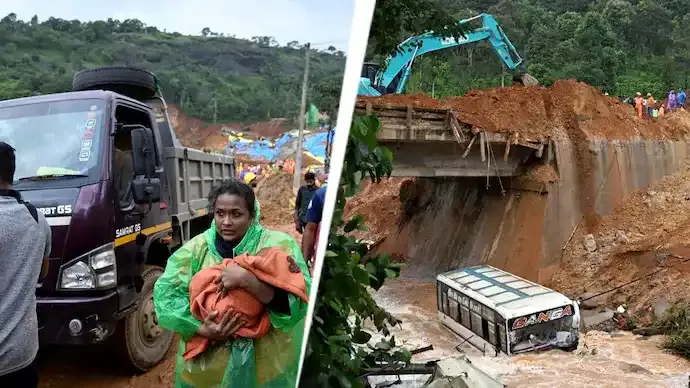

The Kerala government has described the deadly landslide at the Kalladi tunnel construction site in Wayanad as a "man-made disaster", arguing that the tragedy was caused not merely by heavy rainfall but by alleged negligence during the execution of the tunnel project.
The landslide struck amid intense monsoon rains, killing three workers, injuring several others and trapping workers at the construction site of the ambitious Anakkampoyil-Kalladi-Meppadi twin tunnel project, popularly known as the Wayanad Tunnel Project.
What happened in Wayanad?
Heavy rainfall battered Wayanad over the past few days, with the district receiving nearly 265 mm of rain within 24 hours, the highest rainfall recorded this monsoon season.

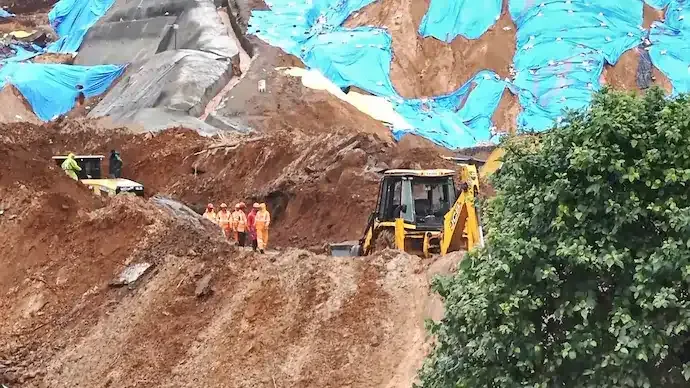
During the downpour, a massive quantity of mud and debris collapsed near the tunnel construction site at Kalladi, burying workers under the landslide.
Rescue teams managed to save around ten workers, while three lost their lives.
Why did Kerala call it a man-made disaster?
According to the Kerala government, the landslide was triggered by improper dumping of excavated soil generated during tunnel construction.
Authorities claim:
- Excavated earth was piled up close to the construction site.
- District authorities had directed the contractor to remove the debris.
- The warnings were allegedly ignored.
- Heavy rainfall washed the accumulated soil downhill, triggering the landslide.
Kerala Agriculture Minister T Siddique said the incident resulted from an "unscientific" method of storing excavated soil rather than being a purely natural landslide.
Government says warnings were ignored
The state government claims that the District Disaster Management Authority and district administration had issued instructions on June 20 directing the contractor to clear the dumped soil.
According to officials, those directions were not followed.
The government argues that compliance with the instructions could have reduced the risk despite heavy rainfall.
Contractor rejects allegations
Construction company Dilip Buildcon, which is executing the tunnel work, disputed the government's assessment.
The company said:
- The rainfall was exceptionally intense.
- The region is naturally prone to landslides.
- The project is being executed under strict regulatory supervision.
- The work is monitored by a Supreme Court-appointed Central Empowered Committee.
The contractor maintained that the unprecedented rainfall was the primary cause of the disaster.
Why the tunnel project has remained controversial
The Rs 2,134-crore Wayanad Tunnel Project is being executed by Konkan Railway Corporation Limited to improve connectivity between Kozhikode and Wayanad.
The 8.17-kilometre twin-tube tunnel aims to:
- Reduce travel time by 45–60 minutes.
- Provide all-weather connectivity.
- Improve transportation across the Western Ghats.
However, environmental groups have opposed the project from the beginning.
Environmental concerns
Several environmental organisations warned that the tunnel passes through the ecologically sensitive Western Ghats, close to areas devastated by major landslides in 2019 and 2024.
Critics argued that:
- The terrain consists of fragile, loose soil.
- Underground excavation could increase landslide risks.
- Heavy monsoon rainfall makes the region especially vulnerable.
Despite these concerns, the Supreme Court allowed the project to proceed after upholding its environmental clearance.
What preliminary investigations suggest
Initial findings indicate that:
- Large quantities of excavated soil were stacked near the tunnel site.
- In some places, debris reportedly accumulated up to 20 feet high.
- Continuous rainfall destabilised the dumped material.
- The accumulated debris slid downhill, triggering the collapse.
Officials have indicated that a detailed investigation will determine whether construction practices violated safety guidelines.
Why this matters
The Wayanad tragedy has reignited the debate over balancing infrastructure development with environmental protection in ecologically fragile regions.
The incident also raises broader questions about compliance with safety regulations, disaster preparedness and accountability during large-scale construction projects in landslide-prone areas.
Featured Snippet
Kerala called the Wayanad tunnel landslide a "man-made disaster" because officials allege excavated soil was dumped unscientifically near the construction site despite repeated warnings to remove it. Heavy rainfall then triggered the collapse, killing three workers.
Key Highlights
- Three workers were killed in the Wayanad tunnel landslide.
- Kerala termed the incident a "man-made disaster."
- Officials blamed unscientific dumping of excavated soil.
- Authorities say earlier warnings to remove the debris were ignored.
- The contractor attributes the incident to exceptionally heavy rainfall.
- The tunnel project has long faced environmental opposition.
- The project cuts through the ecologically sensitive Western Ghats.
- Investigations are underway to determine responsibility.
Conclusion
While torrential monsoon rains undoubtedly contributed to the Wayanad landslide, Kerala maintains that poor construction-site management transformed a natural hazard into a preventable disaster. As investigations continue, the findings are expected to influence not only accountability for the incident but also future infrastructure development in environmentally sensitive regions.
FAQs
1. Why did Kerala call the Wayanad landslide man-made?
The government alleges excavated soil was dumped unscientifically near the construction site despite repeated warnings, making the landslide preventable.
2. Where did the landslide occur?
The incident occurred near the Kalladi section of the Anakkampoyil-Kalladi-Meppadi twin tunnel project in Wayanad district.
3. How many people died in the landslide?
Three workers lost their lives, while around ten others were rescued.
4. What caused the landslide?
According to preliminary findings, heavy rainfall combined with improperly stored excavated soil triggered the collapse. The contractor attributes it primarily to extreme rainfall.
5. What is the Wayanad Tunnel Project?
It is an 8.17-kilometre twin-tube tunnel designed to improve connectivity between Kozhikode and Wayanad by reducing travel time.
6. Why has the project been controversial?
Environmental groups have raised concerns about construction in the ecologically fragile Western Ghats, citing landslide risks and environmental damage.
7. Who is constructing the tunnel?
The project is being executed by Konkan Railway Corporation Limited, with Dilip Buildcon carrying out the tunnel construction work.
8. Is an investigation underway?
Yes. Authorities are conducting detailed investigations to determine whether safety guidelines were violated and to establish accountability.





Conversation
Be kind and stay on topic. Comments are moderated; abuse, spam and personal attacks are removed. Report a problem