

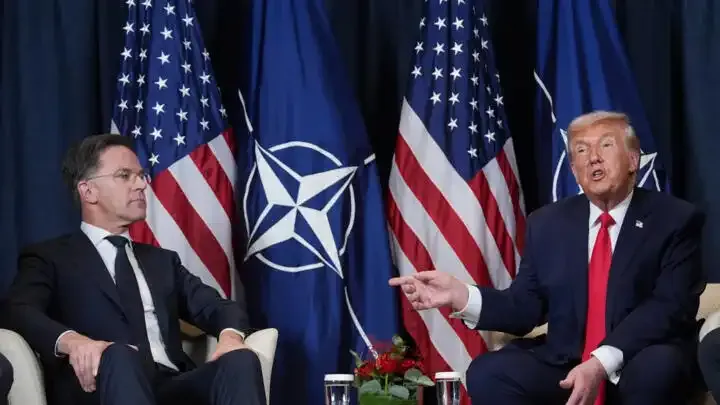

Denmark has firmly rejected US President Donald Trump's renewed demand that the United States take control of Greenland, with Danish Prime Minister Mette Frederiksen insisting the Arctic island is "not for sale" during a tense NATO summit in Ankara.
The disagreement emerged as NATO leaders also discussed US military strikes on Iran, defence spending targets, Ukraine's membership ambitions and the future of the alliance, highlighting growing divisions among member nations.
Denmark says Greenland is not for sale
Responding to Trump's latest remarks, Frederiksen reaffirmed Denmark's position that Greenland's future rests solely with its people.

"Greenland is of course not for sale," she said, adding that all allies should respect the island's right to self-determination, territorial integrity and sovereignty.
The Danish Prime Minister also stressed that Denmark remains committed to defending every inch of NATO territory under the alliance's collective defence principle.
Trump revives Greenland issue
Trump reignited the Greenland debate on the eve of the NATO summit by repeating his long-standing view that the United States should control the strategically important Arctic island.
The remarks revived a diplomatic dispute that first surfaced during his previous presidency, when Denmark rejected a similar proposal to purchase Greenland.
The latest comments come despite NATO's core principle of collective defence among its 32 member nations.
NATO chief backs US on Iran, supports higher defence spending
NATO Secretary-General Mark Rutte defended recent US military action against Iran, describing Washington's response as necessary following renewed regional tensions.
Rutte also supported Trump's push for higher defence spending among NATO members, saying it was reasonable for European allies and Canada to contribute at levels closer to those of the United States.
He noted that several countries, including Poland, Denmark, Greece and the Baltic states, have already increased defence budgets significantly.
Defence spending remains a key issue
A major focus of the summit was NATO's long-term defence spending strategy.
Alliance members have agreed to work towards spending 5% of GDP on defence-related commitments, including:
- 3.5% on military capabilities
- 1.5% on infrastructure supporting military mobility
However, several countries continue to struggle to meet even the earlier 2% benchmark, leaving them under pressure from Washington.
Trump has repeatedly argued that European allies should shoulder a greater share of NATO's security responsibilities.
Ukraine seeks NATO membership
Ukrainian President Volodymyr Zelenskyy used the summit to renew Kyiv's request for NATO membership.
He argued that Ukraine's military experience would strengthen the alliance and pointed to the country's continued operations against Russian forces as evidence of its capabilities.
Zelenskyy was also expected to meet Trump during the summit amid continued discussions on European security.
Greenland's strategic importance
Greenland has become increasingly important due to its:
- Arctic location
- Critical shipping routes
- Rare earth mineral resources
- Expanding military significance
- Climate-driven geopolitical competition
The island remains an autonomous territory within the Kingdom of Denmark, while managing most of its domestic affairs independently.
Summit highlights broader geopolitical challenges
Beyond the Greenland dispute, NATO leaders addressed several major global security issues, including:
- US military action against Iran
- Russia's ongoing war in Ukraine
- Future US military presence in Europe
- Burden-sharing within NATO
- Stability in the Middle East
The discussions underscored the complex challenges facing the alliance as it seeks to maintain unity amid differing national priorities.
Why this matters
Denmark's public rejection of Trump's Greenland proposal highlights growing sensitivities around sovereignty within NATO.
The episode also illustrates how geopolitical competition in the Arctic is becoming increasingly important, while debates over defence spending, Ukraine and the Middle East continue to test alliance cohesion.
Featured Snippet
Denmark rejected Donald Trump's renewed demand for US control of Greenland during the NATO summit in Ankara. Prime Minister Mette Frederiksen said Greenland is "not for sale" and reaffirmed the island's right to self-determination and Danish sovereignty.
Key Highlights
- Denmark rejected Trump's renewed call for US control of Greenland.
- PM Mette Frederiksen said Greenland is "not for sale."
- NATO leaders also discussed Iran, Ukraine and defence spending.
- Mark Rutte backed higher defence spending by alliance members.
- Trump continues pushing allies to increase military budgets.
- Ukraine renewed its appeal for NATO membership.
- Greenland remains strategically important due to its Arctic location.
- The summit highlighted growing geopolitical tensions within NATO.
Conclusion
The NATO summit demonstrated that while alliance members remain committed to collective security, disagreements over sovereignty, defence spending and broader geopolitical priorities continue to create friction. Denmark's firm stance on Greenland reinforces the principle of national sovereignty, even as NATO confronts increasingly complex global security challenges.
FAQs
1. Why did Denmark reject Trump's Greenland proposal?
Denmark said Greenland is not for sale and that its future should be determined solely by the people of Greenland.
2. Why is Greenland strategically important?
Greenland's Arctic location, mineral resources and growing geopolitical significance make it an important territory for global powers.
3. What did Trump say about Greenland?
Trump reiterated that the United States should control Greenland, reviving a proposal first made during his previous presidency.
4. What was discussed at the NATO summit?
Leaders discussed Greenland, Ukraine, Iran, defence spending, NATO expansion and future European security.
5. What is NATO's defence spending target?
NATO members are working towards spending 5% of GDP on defence-related commitments, with 3.5% allocated to military capabilities.
6. Did NATO support US action against Iran?
NATO Secretary-General Mark Rutte publicly supported the recent US military response against Iran.
7. Is Greenland an independent country?
No. Greenland is an autonomous territory within the Kingdom of Denmark, although it governs most of its internal affairs.
8. Why is Ukraine seeking NATO membership?
Ukraine argues that joining NATO would strengthen European security and provide long-term protection against Russian aggression.





Conversation
Be kind and stay on topic. Comments are moderated; abuse, spam and personal attacks are removed. Report a problem