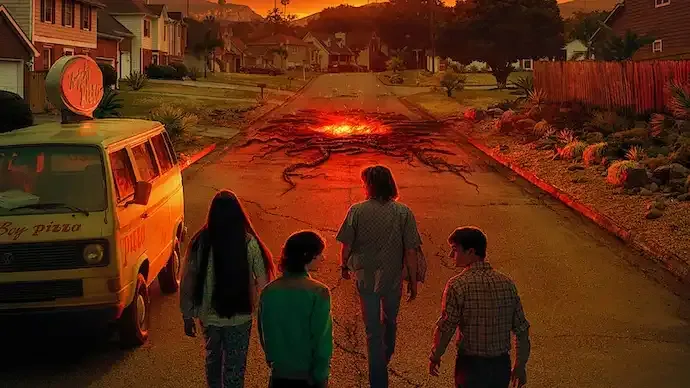
After nearly a decade, Stranger Things has reached its conclusion, and the silence it leaves behind feels heavier than the end of most television shows. What began in 2016 as a supernatural mystery set in a small Indiana town has evolved into something far more personal for its audience. As the series signs off, viewers across generations are not just closing a story, but parting with a space that felt emotionally familiar — almost like home.
Set in the fictional town of Hawkins, the show’s lasting impact was never confined to its monsters, alternate dimensions or Cold War anxieties. Its real power lay in how convincingly it recreated emotional connection. Hawkins was written as a place where friendships were formed face-to-face, where boredom sparked adventure, and where loyalty was instinctive rather than curated. These elements transcended time, making the series resonate with viewers regardless of age.
For those who grew up in the 1970s and 80s, the world of Hawkins felt recognisable — bicycles lining quiet streets, basements doubling as safe havens, and friendships unfolding without constant digital interruption. For younger audiences, the connection was different but equally strong. The show offered a longing for slower, more tangible relationships — a contrast to a present dominated by screens, notifications and distance disguised as connection.
Rather than recreating the 1980s as a historical period, the series transformed it into an emotional language. Hawkins became a feeling: a place where danger was close but manageable, where courage came naturally, and where belonging was earned through shared experiences. The physical textures of the show — flickering lights, crackling radios, torchlight in the dark — made the world feel lived-in and real.
The ending carries particular emotional weight because the series has always been about time. When it premiered, its central characters were children standing at the edge of adolescence. Over the years, viewers watched them grow up, confront loss and face increasingly complex realities. In parallel, audiences themselves moved through different phases of life, often returning to Hawkins during moments of personal change.
As innocence faded and the tone darkened, the series mirrored the uncomfortable truth of growing up. Childhood certainty gave way to ambiguity, and simple moral boundaries became harder to navigate. Watching these characters evolve forces viewers to reflect on their own journeys — on who they were when the show began and how much has changed since.
This is where the show’s farewell becomes deeply personal. Letting go of Hawkins feels like letting go of a younger version of oneself — a time when friendships felt absolute and the world, though frightening, still seemed conquerable. The final moments don’t just conclude a narrative; they invite reflection, nostalgia and a quiet reckoning with time passed.
In the end, Hawkins was never just a setting. It was a carefully crafted memory of belonging, safety and chosen family. As the lights dim and the music fades, viewers return to a louder, faster world — carrying with them the ache of leaving a place that once felt like refuge.
That is why the goodbye hurts. It is not only the end of a series, but the closing of a shared emotional chapter that many didn’t realise had become part of their own lives.
Prev Article
Shah Rukh Khan–Mustafizur Rahman IPL Row: Mohammad Kaif Urges BCCI to Decide Wisely
Next Article
Why Festivals Complicate Family and Partner Dynamics More Than We Expect