
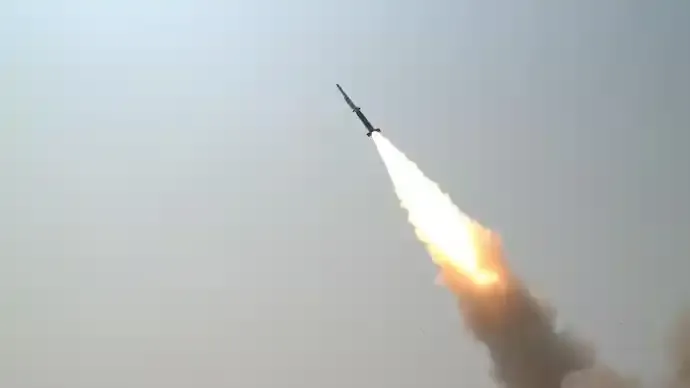
India has marked a significant milestone in indigenous defence innovation after Defence Research and Development Organisation (DRDO) successfully demonstrated Solid Fuel Ducted Ramjet (SFDR) propulsion technology, a major advancement expected to strengthen the country’s next-generation air-to-air missile capabilities. The test was conducted at the Integrated Test Range, Chandipur off the Odisha coast, placing India among a small group of nations possessing advanced ramjet-powered missile systems.
The SFDR technology is designed to enable long-range, high-speed missiles capable of sustaining thrust during critical phases of flight. Defence experts believe the development could significantly enhance beyond-visual-range combat capabilities for Indian fighter jets, allowing pilots to engage threats from greater distances while maintaining superior manoeuvrability.
What is ramjet technology?
A ramjet is an air-breathing propulsion system that uses the forward motion of a missile to compress incoming air instead of relying on mechanical compressors or turbines. In a ramjet engine, atmospheric air mixes with fuel and burns to generate sustained thrust at supersonic speeds. Unlike conventional rocket motors, which burn fuel rapidly and then glide toward the target, ramjet-powered missiles maintain energy for longer durations, especially in the terminal phase of flight.
The Solid Fuel Ducted Ramjet variant uses a specially designed solid fuel that burns gradually as airflow passes through the engine. This allows the missile to maintain high speed and agility, making interception or evasion more difficult for enemy aircraft.
How the test was conducted
During the flight demonstration, the missile was initially accelerated by a ground-based booster to reach the required speed. Once the system achieved the necessary Mach number, the ramjet propulsion took over, sustaining high velocity throughout the mission profile.
DRDO officials confirmed that critical subsystems — including the nozzle-less booster, fuel flow control mechanism, and ramjet motor — functioned as planned. The missile’s trajectory and performance were tracked through advanced telemetry and monitoring systems deployed along the Bay of Bengal coastline. Scientists from multiple DRDO laboratories observed the test to validate propulsion efficiency and stability under supersonic conditions.
Strategic importance for Indian fighter jets
The successful SFDR demonstration has far-reaching implications for India’s air combat strategy. Ramjet-powered missiles allow fighter aircraft to strike targets at extended ranges while retaining high kinetic energy near impact. This provides a tactical advantage in aerial engagements, enabling pilots to neutralise threats earlier and reduce exposure to enemy countermeasures.
Globally, only a handful of countries have mastered ramjet propulsion due to the engineering complexity involved in maintaining stable combustion at extreme speeds. For India, this breakthrough supports long-term defence self-reliance and reduces dependence on foreign missile technologies.
Experts believe the SFDR programme will contribute to future indigenous missile projects, improving the operational edge of the Indian Air Force and strengthening India’s position in advanced aerospace research. As defence modernisation accelerates, ramjet technology is expected to play a central role in shaping the next generation of Indian fighter jet weapon systems.






Conversation
Be kind and stay on topic. Comments are moderated; abuse, spam and personal attacks are removed. Report a problem