

Shopping cart
Your cart empty!
Terms of use dolor sit amet consectetur, adipisicing elit. Recusandae provident ullam aperiam quo ad non corrupti sit vel quam repellat ipsa quod sed, repellendus adipisci, ducimus ea modi odio assumenda.
Lorem ipsum dolor sit amet consectetur adipisicing elit. Sequi, cum esse possimus officiis amet ea voluptatibus libero! Dolorum assumenda esse, deserunt ipsum ad iusto! Praesentium error nobis tenetur at, quis nostrum facere excepturi architecto totam.
Lorem ipsum dolor sit amet consectetur adipisicing elit. Inventore, soluta alias eaque modi ipsum sint iusto fugiat vero velit rerum.
Sequi, cum esse possimus officiis amet ea voluptatibus libero! Dolorum assumenda esse, deserunt ipsum ad iusto! Praesentium error nobis tenetur at, quis nostrum facere excepturi architecto totam.
Lorem ipsum dolor sit amet consectetur adipisicing elit. Inventore, soluta alias eaque modi ipsum sint iusto fugiat vero velit rerum.

Dolor sit amet consectetur adipisicing elit. Sequi, cum esse possimus officiis amet ea voluptatibus libero! Dolorum assumenda esse, deserunt ipsum ad iusto! Praesentium error nobis tenetur at, quis nostrum facere excepturi architecto totam.
Lorem ipsum dolor sit amet consectetur adipisicing elit. Inventore, soluta alias eaque modi ipsum sint iusto fugiat vero velit rerum.
Sit amet consectetur adipisicing elit. Sequi, cum esse possimus officiis amet ea voluptatibus libero! Dolorum assumenda esse, deserunt ipsum ad iusto! Praesentium error nobis tenetur at, quis nostrum facere excepturi architecto totam.
Lorem ipsum dolor sit amet consectetur adipisicing elit. Inventore, soluta alias eaque modi ipsum sint iusto fugiat vero velit rerum.

Do you agree to our terms? Sign up
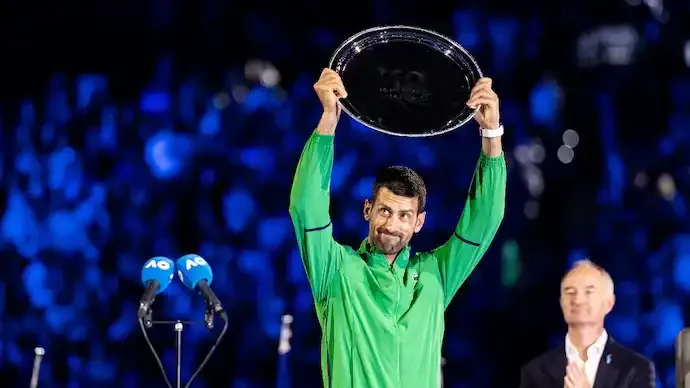
At 38, Novak Djokovic may have fallen short of a historic 25th Grand Slam title, but his run at the Australian Open delivered a far more disruptive message to men’s tennis: the new order is not settled, and the old king is not done. In an era increasingly defined by the Carlos Alcaraz–Jannik Sinner duopoly, Djokovic once again proved that time bends differently around him.
Coming into the season-opening major in Melbourne, the narrative around men’s tennis felt almost fixed. Alcaraz and Sinner had won every Grand Slam over the previous two years, and Djokovic’s dominance appeared to be receding. Since lifting the US Open in 2023, the Serbian had reached only one major final. In 2025, he failed to progress beyond the semifinals at any of the four Slams, and after a heavy defeat in New York, even Djokovic acknowledged the growing challenge of beating the sport’s new standard-bearers over five sets.
That sense of inevitability followed him to Melbourne. Discussions revolved around Alcaraz’s pursuit of a Career Grand Slam and Sinner’s attempt to assert long-term supremacy. Djokovic, placed in Sinner’s half of the draw, was rarely mentioned as a serious threat. Yet, as has so often been the case across his career, dismissal became fuel.
Djokovic’s path to the final was not flawless, but it was telling. A fourth-round walkover provided crucial recovery time, and a quarterfinal escape—helped by an opponent’s retirement—kept him alive. Then came the defining moment: a semifinal against the world No. 1. Against Sinner, younger, fresher and widely viewed as unbeatable in Melbourne, Djokovic summoned a familiar defiance.
After losing the opening set, he flattened rallies, absorbed pace and injected doubt into a player who had looked untouchable. The five-set victory was vintage Djokovic—part tactical brilliance, part mental endurance. His celebration at Rod Laver Arena felt less like a semifinal win and more like a declaration that he still belonged at the summit.
The final against Alcaraz arrived quickly, with minimal recovery and a 16-year age gap staring him down. Yet Djokovic struck first, dismantling the Spaniard in the opening set with a level of returning and aggression that briefly transported the crowd back to his peak years. For a moment, the clock appeared to turn backwards.
Eventually, reality intervened. Alcaraz adjusted, extended rallies and exploited Djokovic’s movement, forcing him to cover the court relentlessly. As the match wore on, youth and freshness prevailed. Djokovic’s legs faded, but his belief did not.
What this Australian Open run ultimately revealed was not decline, but vulnerability—on the other side. Alcaraz and Sinner may be the present and future of men’s tennis, but Djokovic showed that their dominance is not absolute. Beating one of them at a Slam, at 38, was a step forward from his previous season and a reminder that the gap is difficult, not unbridgeable.
Nearly two decades after breaking the Federer–Nadal stronghold as a 22-year-old, Djokovic is once again standing against a new duopoly. He remains tennis’ great disruptor—the Benjamin Button of the baseline—aging in reverse when the sport expects him to fade, and refusing to accept that impossible is final.
30
Published: Feb 02, 2026