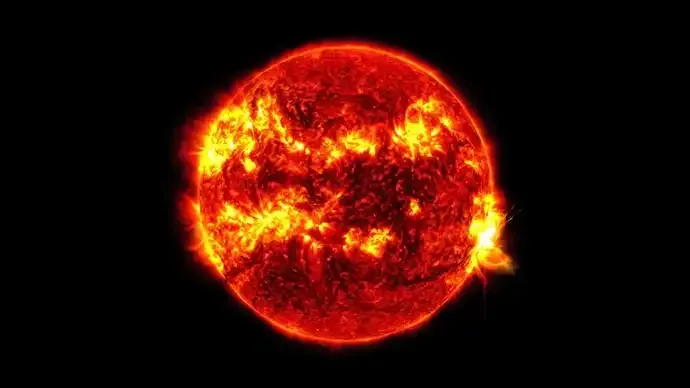
A team of Indian scientists has uncovered how seemingly weak and almost invisible solar eruptions can intensify into powerful geomagnetic storms capable of disrupting satellites, power grids, and communication systems on Earth. The findings shed new light on one of the most challenging problems in space weather forecasting—detecting and predicting so-called “stealth” solar events.
Researchers from the Indian Institute of Astrophysics analysed a subtle solar eruption that occurred on March 19, 2023. Unlike typical solar outbursts, this event showed no strong X-ray flares or radio signals, making it difficult to identify using conventional monitoring techniques. Despite its quiet origin, the eruption later triggered an intense geomagnetic storm upon reaching Earth.
Under normal circumstances, major geomagnetic storms are linked to large coronal mass ejections (CMEs)—huge expulsions of plasma and magnetic fields from the Sun’s outer atmosphere. However, scientists estimate that nearly 10 per cent of severe space weather events originate from stealth CMEs, which lack obvious early warning signs. The 2023 eruption is now considered a textbook example of how dangerous such hidden events can be.
The eruption originated from a filament channel close to the centre of the Sun and was tracked using a network of space-based observatories, including NASA’s Solar Dynamics Observatory, Solar Orbiter, STEREO-A, and the WIND spacecraft. Though the initial eruption appeared weak, it reached Earth roughly three days later and unleashed a strong geomagnetic storm.
According to lead researcher P Vemareddy, the challenge with such events is that they leave almost no detectable signatures on the solar surface. This makes them extremely difficult to spot in real time. The study found that a nearby coronal hole—an area where the Sun’s magnetic field opens into space—played a crucial role in accelerating the CME. High-speed solar wind streams from this coronal hole propelled the eruption outward, preventing it from dissipating close to the Sun.
Using in-situ measurements, the researchers tracked how the interplanetary CME evolved as it travelled through space. The structure expanded significantly, its speed gradually decreased, and its magnetic cloud rotated in a manner consistent with its solar origin. Most importantly, the CME developed strong southward-pointing magnetic fields, which are known to interact efficiently with Earth’s magnetosphere and trigger geomagnetic storms.
The team also modelled key geomagnetic indices using solar wind speed, plasma density, and magnetic field data. Their simulations closely matched real-world observations, demonstrating that even weak-looking solar eruptions can become highly disruptive by the time they reach Earth.
The findings were published in The Astrophysical Journal under the title An Intense Geomagnetic Storm Originated from Stealth Coronal Mass Ejection. The research calls for improved detection systems, greater reliance on multi-spacecraft observations, and refined forecasting models—especially as the Sun approaches the peak of Solar Cycle 25.
As solar activity increases, scientists warn that stealth CMEs pose a growing threat to aviation, GPS navigation, satellites, and critical infrastructure. The study highlights India’s growing role in global heliophysics research, demonstrating how subtle solar events can evolve into powerful storms with real-world consequences on Earth.
Prev Article
Patient Survives 48 Hours Without Lungs Using Artificial Organ in Medical First
Next Article
Women Secretly Filmed With Smart Glasses: How Wearable Tech Is Becoming a Safety Threat