
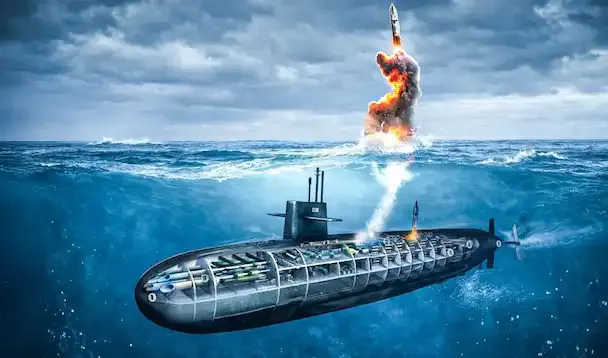
India has reportedly conducted a test of a nuclear-capable submarine-launched ballistic missile (SLBM), marking another quiet but significant step in strengthening its second-strike nuclear capability. Although the test has not been officially acknowledged, it underlines New Delhi’s steady progress in reinforcing the credibility of its nuclear deterrence under the No First Use (NFU) policy.
India’s nuclear doctrine, adopted in 2003, commits the country to never being the first to use nuclear weapons. However, it also clearly states that any nuclear attack on India would invite massive retaliation designed to inflict unacceptable damage. For such a doctrine to be credible, India must possess an assured second-strike capability — the ability to retaliate even after absorbing a potential first strike.
The most secure way to guarantee this capability lies deep underwater.
Silent deterrence beneath the seas
India is believed to have tested the K-4 SLBM earlier this week. With a reported range of around 3,500 km, the missile represents a major leap over earlier systems. This is understood to be the second test of the K-4, following an earlier launch in late 2024. Both tests have remained unconfirmed, consistent with India’s long-standing policy of opacity around its nuclear arsenal.
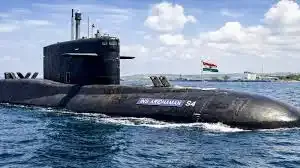
At present, India operates two nuclear-powered ballistic missile submarines (SSBNs) — INS Arihant and INS Arighaat — with two more in advanced stages of development and sea trials.
SSBNs are the backbone of any credible second-strike capability. Unlike land-based missile silos or aircraft, these submarines can remain submerged for months, hidden from satellites and radar. Powered by nuclear reactors, their endurance is limited largely by crew stamina and supplies, making them extremely difficult to detect or neutralise in a first strike.
Why missile range matters
India’s first operational SLBM, the K-15 with a range of about 750 km, was a technological milestone but a strategic constraint. Submarines armed with such short-range missiles would need to sail close to adversary coastlines, increasing the risk of detection.
The K-4 changes this equation. Its longer range allows Indian SSBNs to remain within relatively secure waters such as the Bay of Bengal, while still being able to target key strategic locations across Pakistan and large parts of China. This significantly enhances survivability and deterrence credibility.

The road ahead
India’s undersea deterrent is expected to grow further. The Defence Research and Development Organisation is reportedly working on longer-range missiles such as the K-5 and K-6, alongside a new generation of larger SSBNs under the S5 project. These submarines are expected to be significantly bigger than the Arihant class and capable of carrying heavier, longer-range missiles.
Once operational, they would place India among the small group of nations with a fully mature sea-based nuclear deterrent.
For now, India’s Arihant-class submarines continue their silent patrols, hidden beneath the ocean, ensuring that the country’s second-strike promise remains intact — a deterrent designed to ensure that a nuclear first strike against India remains an unthinkable option.



Conversation
Be kind and stay on topic. Comments are moderated; abuse, spam and personal attacks are removed. Report a problem