

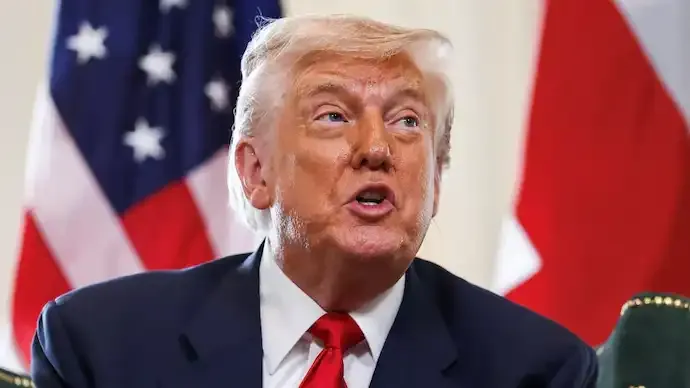

US President Donald Trump has blamed Canada for the wildfire smoke drifting into large parts of the United States, accusing Ottawa of failing to properly manage its forests and warning that the resulting economic costs could be reflected in higher tariffs on Canadian imports.
In a post on Truth Social, Trump described the smoke as an "unnecessary invasion" of polluted air and said he planned to discuss the issue with Canadian Prime Minister Mark Carney.
His comments come as smoke from Canada's ongoing wildfire season has triggered widespread air quality alerts across the United States, adding another point of friction to already strained trade relations between the two neighbours.

Trump Calls Smoke 'Willful Negligence'
Trump described the recurring wildfire smoke as the result of "willful negligence," arguing that Canada's forest management practices have allowed the problem to persist.
He said the smoke has caused billions of dollars in economic damage to the United States and warned that those costs "must of necessity be added to the tariffs Canada is currently paying."
The President also said he intends to ask the Canadian government what measures it plans to take to prevent similar incidents in the future.
Millions Affected by Poor Air Quality
According to US authorities, more than 100 million people across 18 states and the District of Columbia were under air quality alerts due to smoke from Canadian wildfires.
Officials warned that air conditions ranged from "very unhealthy" to "hazardous" in several areas stretching from northeast Minnesota to southeast Virginia.
Health officials have advised vulnerable groups, including children, older adults and people with respiratory conditions, to limit outdoor activities during periods of poor air quality.

Trade Tensions Continue to Rise
Trump's remarks also come against the backdrop of broader trade disputes between Washington and Ottawa.
Following a recent US Supreme Court ruling that limited the President's ability to impose tariffs using emergency powers, the administration has explored alternative legal mechanisms that require formal investigations and public consultation before introducing new trade duties.
Despite those procedural hurdles, the White House has maintained that it intends to preserve its broader tariff strategy.
Canada Remains a Frequent Target
Canada has repeatedly been the focus of Trump's criticism on trade issues, including disputes involving lumber exports, automobile manufacturing, and market access.
Although many Canadian products continue to receive protections under the United States-Mexico-Canada Agreement (USMCA), uncertainty over future trade relations has increased after the administration chose not to renew the agreement in its current form earlier this month.
Trump's latest comments suggest environmental issues could now become another factor influencing US-Canada economic relations.
Wildfires Add New Dimension to Bilateral Relations
Canada has experienced increasingly severe wildfire seasons in recent years, with smoke regularly spreading into the United States during the summer months.
Trump's decision to connect wildfire management with tariff policy introduces a new dimension to the long-running economic and diplomatic relationship between the two countries.
Whether the issue results in additional trade measures remains uncertain, but it is likely to feature in upcoming discussions between Washington and Ottawa.
Key Highlights
- Donald Trump blamed Canada for wildfire smoke affecting large parts of the United States.
- He described the smoke as the result of "willful negligence."
- Trump warned that the economic costs of the pollution could be added to tariffs on Canadian goods.
- More than 100 million Americans were under air quality alerts across 18 states and Washington, DC.
- The remarks add to ongoing trade tensions between the United States and Canada.
FAQs
Why did Donald Trump criticise Canada?
Trump accused Canada of failing to properly manage its forests, saying wildfire smoke drifting into the US was causing economic and public health damage.
What did Trump say about tariffs?
He warned that the financial impact of the wildfire smoke could be added to tariffs already imposed on Canadian goods.
How many people were affected by the wildfire smoke?
US authorities said more than 100 million people across 18 states and the District of Columbia were under air quality alerts.
Who is Canada's Prime Minister?
Canada's Prime Minister is Mark Carney, whom Trump said he plans to speak with regarding the wildfire situation.
Why are US-Canada trade tensions increasing?
The two countries continue to disagree on issues including tariffs, lumber, automobile manufacturing, trade agreements and now wildfire-related pollution.






Conversation
Be kind and stay on topic. Comments are moderated; abuse, spam and personal attacks are removed. Report a problem