
Just ahead of World Wetlands Day on February 2, India has added two more wetlands to the globally recognised Ramsar list, strengthening the country’s position as one of the world’s leading custodians of wetland biodiversity.
The newly designated sites — Patna Bird Sanctuary in Uttar Pradesh and Chhari Dhand in Gujarat — have been recognised as wetlands of international importance under the Ramsar Convention. With these additions, India’s Ramsar tally has risen from 96 to 98 sites.
The announcement was made by Union Minister for Environment, Forest and Climate Change Bhupender Yadav, who congratulated state governments, conservationists and local communities for their role in protecting these fragile ecosystems.
Prime Minister Narendra Modi also welcomed the development, saying the recognitions reaffirm India’s commitment to preserving biodiversity. He highlighted that since 2014, India’s Ramsar network has expanded by more than 276 per cent, growing from just 26 sites to nearly 100 today.
Patna Bird Sanctuary: A small wetland with massive ecological value
Located in Etah district’s Jalesar subdivision, the Patna Bird Sanctuary is Uttar Pradesh’s smallest bird sanctuary, covering just over one square kilometre. Despite its modest size, it plays a crucial role in sustaining avian biodiversity.
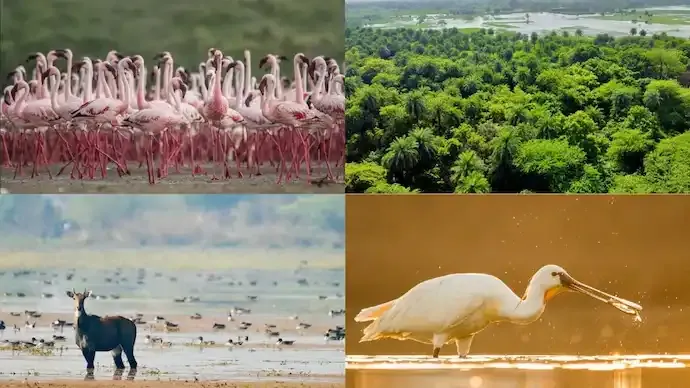
According to the Ministry of Environment, Forest and Climate Change, the sanctuary hosts more than 60,000 birds during peak winter months. Migratory species such as the Rosy Pelican and Eurasian Spoonbill are regular visitors, while the Northern Pintail often dominates the migratory population.
The wetland also supports resident wildlife and surrounding ecosystems, providing habitat for endangered bird species and mammals like the Nilgai, or Blue Bull. As a shallow, rain-fed lake system, Patna Bird Sanctuary serves as an essential resting and feeding ground along migratory routes in northern India.
Chhari Dhand: A lifeline in the arid landscape of Kutch
In sharp contrast, Chhari Dhand lies in the arid region of Kutch, Gujarat. The name “Chhari Dhand” translates to a salt-affected shallow wetland, reflecting the unique ecological character of the site. During strong monsoon years, the wetland expands to nearly 80 square kilometres.
Chhari Dhand is Gujarat’s only Conservation Reserve and functions as a major stopover for migratory birds entering the Indian subcontinent via the western flyway. The site supports large congregations of Common Cranes, Greater Flamingos and the iconic Lesser Flamingo.
Beyond birds, the wetland provides habitat for rare and threatened mammals, including chinkara, wolves, caracals, desert cats and desert foxes. The surrounding Banni grasslands are also known for the mysterious “Chir Batti” phenomenon — unexplained ghost lights observed on dark nights.
Strengthening India’s wetland conservation footprint
Wetlands play a vital role in climate resilience, groundwater recharge, flood control and biodiversity conservation. By adding Patna Bird Sanctuary and Chhari Dhand to the Ramsar list, India has reinforced its global commitment to protecting ecosystems that support both wildlife and local livelihoods.
With World Wetlands Day approaching, the latest recognitions underscore the importance of community participation, scientific management and sustained policy support in safeguarding India’s natural heritage.




Conversation
Be kind and stay on topic. Comments are moderated; abuse, spam and personal attacks are removed. Report a problem