

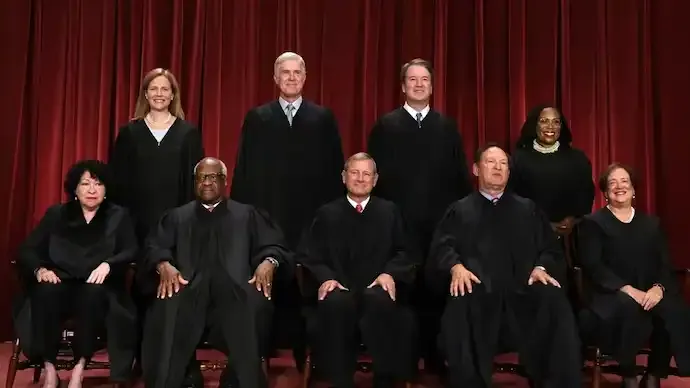

In a landmark 6–3 decision, the United States Supreme Court struck down sweeping global tariffs imposed by President Donald Trump under the International Emergency Economic Powers Act (IEEPA). The court ruled that while the president holds emergency powers, those powers do not extend to imposing broad tariffs, as the Constitution grants authority over taxation and duties to Congress.
The judgment is being viewed as a significant ruling on separation of powers and executive authority in trade policy.
Below is a breakdown of the justices who formed the majority and those who dissented.

Justices Who Ruled Against the Tariffs (Majority)
John Roberts (Chief Justice)
Chief Justice Roberts authored the majority opinion. He concluded that the IEEPA does not grant the president unilateral authority to impose sweeping tariffs. Roberts framed the issue as a constitutional separation-of-powers matter, emphasizing that tariff authority lies with Congress.

Neil Gorsuch
Justice Gorsuch, a conservative appointee of Trump, joined the majority. His vote drew attention due to his judicial philosophy emphasizing statutory interpretation and limits on executive power.

Amy Coney Barrett
Justice Barrett also joined the majority opinion. Her vote was notable because she was appointed by Trump, reinforcing the court’s independence in constitutional interpretation.

Sonia Sotomayor
Justice Sotomayor supported the majority view that the emergency law does not authorize tariffs. Her position reflected concerns about executive overreach and the need for clear congressional approval.

Elena Kagan
Justice Kagan joined the majority and wrote a concurring opinion. She argued the case could be resolved through straightforward statutory interpretation without invoking broader constitutional doctrines.

Ketanji Brown Jackson
Justice Jackson joined the majority and wrote separately, noting that legislative history supports the conclusion that Congress never intended the emergency law to grant tariff authority.

Justices Who Dissented
Brett Kavanaugh
Justice Kavanaugh authored the principal dissent. He argued that the tariffs were lawful under the statute and historical practice, warning the ruling could create practical complications, including potential refund disputes.

Clarence Thomas
Justice Thomas joined the dissent and emphasized that Congress can delegate trade powers to the executive branch. He cited constitutional structure and historical precedent supporting presidential authority over foreign commerce.

Samuel Alito
Justice Alito also dissented, agreeing that the statute permitted tariff authority and cautioning against limiting executive power through judicial interpretation.

Why the ruling matters
The decision reinforces congressional authority over tariffs and taxation while clarifying limits on presidential emergency powers. Legal experts say the ruling may influence future trade policies and executive actions involving economic measures.
The split also highlights ideological and interpretive differences within the court regarding executive authority, statutory interpretation, and constitutional boundaries.






Conversation
Be kind and stay on topic. Comments are moderated; abuse, spam and personal attacks are removed. Report a problem