

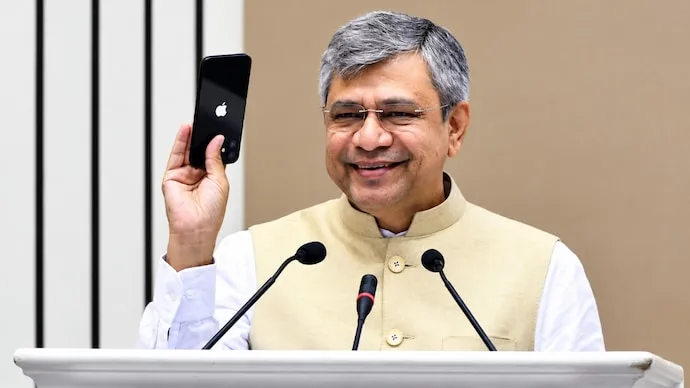

India’s mobile manufacturing PLI scheme has come under renewed scrutiny after Union Electronics and IT Minister Ashwini Vaishnaw defended government incentives for smartphone production, citing tax collections and employment figures. His response followed a Bloomberg report questioning whether India retains enough domestic economic value from iPhone manufacturing to justify public spending.
On October 27, Vaishnaw shared figures on X stating that the government had paid ₹19,000 crore in mobile manufacturing incentives while collecting ₹25,000 crore in direct taxes and approximately ₹3 lakh crore in Goods and Services Tax (GST). He added that electronics manufacturing employs 25 lakh people, including 12 lakh in mobile manufacturing, and ended his post with the phrase “Cope harder!!” aimed at critics.
Why Bloomberg Questioned India’s iPhone Manufacturing Push
Bloomberg Opinion columnist Andy Mukherjee examined an iPhone’s components in a video report, highlighting India’s progress in electronics manufacturing while questioning its dependence on imported parts.

Mukherjee acknowledged that Indian factories had moved from importing pre-assembled mainboards to importing bare circuit boards and installing electronic components locally. He estimated that this shift improved India’s mobile trade balance by $2.1 billion in a year.
India has also expanded its role in Apple’s global supply chain, with roughly one in every four iPhones reportedly manufactured domestically. However, the report highlighted continued dependence on overseas suppliers for memory chips, processors, displays, camera lenses and batteries.
It questioned whether component import costs could outweigh earnings from finished handset exports and whether subsidies would deliver sufficient economic returns if manufacturing costs remained high.
Semiconductor Subsidies Add to the Debate
The discussion echoes concerns raised by former RBI governor Raghuram Rajan, who questioned the rationale for investing billions of dollars in domestic semiconductor manufacturing. Rajan argued that India should carefully assess which industries require domestic production, given the continued dependence of chip manufacturing on imported machinery and materials.
Zoho founder Sridhar Vembu, meanwhile, defended India’s semiconductor ambitions, arguing that the country needs to build its own technological capabilities.
Government Points to Manufacturing Growth
The Centre views the PLI scheme as a tool for increasing domestic production, attracting investment and creating jobs. Government figures cited in Parliament in July 2025 showed that the large-scale electronics manufacturing scheme had attracted ₹12,390 crore in cumulative investment and generated ₹8.44 lakh crore in production by June 2025. Mobile phone exports under the scheme had reached ₹4.65 lakh crore.
India has emerged as the world’s second-largest mobile phone manufacturer, while smartphones have become a leading export category.
The debate ultimately centres on how India should measure success: through production, exports, tax revenue and employment, or through deeper domestic value addition and reduced dependence on imported components.
Official link: Ministry of Electronics and Information Technology





Conversation
Be kind and stay on topic. Comments are moderated; abuse, spam and personal attacks are removed. Report a problem