

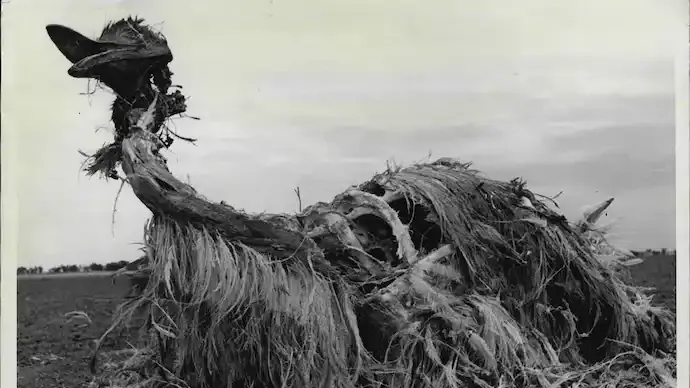

It sounds like satire: a modern nation deploying soldiers with machine guns to fight giant flightless birds — and losing. Yet this is exactly what unfolded in Australia in 1932, in the episode now famously known as the Great Emu War.
Although the events are often recalled humorously today, the “war” grew out of a desperate economic and agricultural crisis for farmers already hit hard by the Great Depression.
A Farming Crisis Meets an Emu Migration
In the early 1930s, wheat prices had collapsed, Western Australia’s farmers were struggling, and the land was proving difficult to cultivate. Then came an unexpected invasion.

Every year, emus migrate from inland deserts toward coastal regions. But in 1932, their numbers surged to nearly 20,000 birds. The newly developed farmlands and water sources became a magnet for the migrating emus.
For farmers, the consequences were severe:
✔️ crops destroyed overnight
✔️ fences broken
✔️ fields flattened
They demanded government intervention — and got it.
Machine Guns vs Emus: An Unusual Military Mission
In November 1932, the Australian government deployed the army to help farmers. Major GPW Meredith and his team arrived equipped with two Lewis machine guns and 10,000 rounds of ammunition.
What followed quickly turned into an unintentional comedy of errors.
Despite their size — reaching up to 1.9 meters — emus were:
✔️ incredibly fast (up to 50 km/h)
✔️ scattered in small groups
✔️ unpredictable and hard to target
Ambushes failed. Guns jammed. Chases on bumpy terrain were useless. Emus simply sprinted away every time.
Major Meredith later commented that if the Australian military ever needed skilled guerilla fighters, emus would make excellent recruits.
A War Silently Abandoned
By early December, thousands of rounds had been fired, but only a small percentage of the birds were hit. The campaign was quietly discontinued, becoming a global source of ridicule for Australia.
Newspapers mocked the idea of soldiers with automatic weapons losing to birds.
But the failure carried a deeper message: wildlife management cannot be substituted with force. Eventually, Australia adopted more practical solutions like reinforced fencing and improved land practices instead of military intervention.
The Enduring Legacy of the Emu War
Today, the Emu War symbolizes nature’s ability to outwit human strategies with nothing more than instinct and speed. It remains one of history’s most bizarre conflicts — and a reminder that coexistence is more effective than confrontation, especially when wildlife is simply following its natural path.
In the end, Australia didn’t just lose a “war” to birds. It gained one of the most memorable lessons in environmental history: never underestimate an emu.









Conversation
Be kind and stay on topic. Comments are moderated; abuse, spam and personal attacks are removed. Report a problem