NITI Aayog organised a two-day national workshop aimed at strengthening state-level research and innovation ecosystems, underscoring the growing importance of embedding research and development (R&D) within government institutions to support evidence-based policymaking and long-term development.
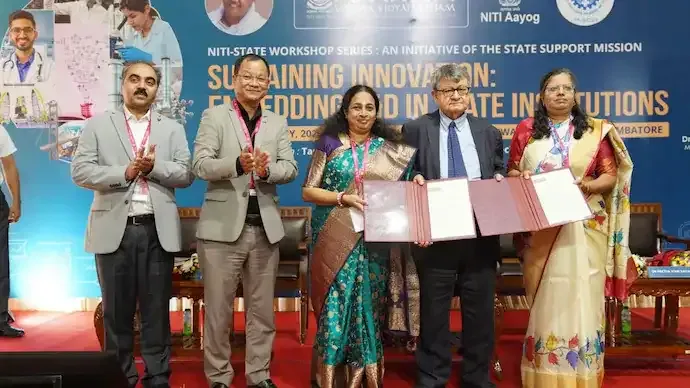
Titled “Sustaining Innovation: Embedding R&D in State Institutions”, the workshop concluded on January 9 at Amrita Vishwa Vidyapeetham in Coimbatore. The event brought together policymakers, scientists, academicians and representatives from research organisations across India to deliberate on building resilient and outcome-oriented innovation frameworks at the state level.
The discussions focused on how state governments can institutionalise R&D processes to ensure that innovation directly contributes to public welfare, scalable solutions and sustainable economic growth. The workshop was held in collaboration with the Tamil Nadu State Council for Science and Technology, reflecting a growing emphasis on state-driven innovation strategies.
Aligning Research With National Priorities
Addressing participants, Suman Bery highlighted the need for research institutions to remain grounded in real-world challenges. He emphasised that innovation must be aligned with national priorities and societal needs, noting that technology-driven solutions can play a decisive role in addressing contemporary governance and development challenges when applied purposefully.
The opening session stressed that research outcomes should not remain confined to academic spaces but must actively inform policy design and implementation at both state and national levels.
Role of Universities and Inclusive Innovation
The workshop opened with a focus on the responsibility of universities in nurturing strong and sustainable R&D ecosystems. Speakers highlighted how higher education institutions can serve as innovation anchors by connecting scientific research with governance needs and grassroots realities.
A recorded message by spiritual leader and Chancellor of Amrita Vishwa Vidyapeetham emphasised inclusion, compassion and responsible technology use as essential pillars of development. Senior policymakers also underlined that embedding R&D deeply within institutional frameworks is critical to ensuring innovation that is continuous, impactful and inclusive.
Tamil Nadu’s leadership in innovation was highlighted during the deliberations, with the state emerging as one of India’s top contributors to patent filings. Participants noted that institutional support and academia–government collaboration have played a key role in driving this momentum.
Key Outcome: MoU to Strengthen Science–Policy Linkages
One of the major outcomes of the workshop was the signing of a Memorandum of Understanding between Amrita Vishwa Vidyapeetham and the CSIR–National Institute of Science Communication and Policy Research. The MoU aims to strengthen collaboration in science communication, policy research and innovation-led development, helping bridge the gap between scientific research and policy execution.
The agreement reflects a broader push to formalise partnerships that translate research insights into actionable governance frameworks.
Policy-Focused Discussions and Recommendations
Over two days, the workshop featured technical sessions and panel discussions on strengthening State Science and Technology Councils, designing state-level innovation missions and aligning grassroots innovation with policy mechanisms. Participants shared best practices and explored institutional models that can help states build robust R&D ecosystems tailored to their development priorities.
The deliberations concluded with shared insights and broad recommendations focused on creating inclusive, technology-enabled and impact-driven research frameworks across Indian states. The event was attended by nearly 80 participants representing government departments, academic institutions and research organisations nationwide.
Prev Article
Pariksha Pe Charcha 2026 Breaks Guinness Record With 4.3 Crore Registrations
Next Article
Tamil in Varanasi Schools: New Language Initiative Strengthens Cultural Exchange